The Thomas Crown Affair: one cut, a wardrobe of three-pieces
Updated October 2026 · Sam’s Menswear editorial team
Thomas Crown is a Boston millionaire who robs a bank because he is bored. Steve McQueen plays him in Norman Jewison’s 1968 film (the original, not the 1999 remake) as a man with everything, and his wardrobe is the most convincing evidence: one three-piece suit after another, each one fitting like the last.
Men who look these suits up usually like the look and doubt the waistcoat. In 2026 a three-piece tends to mean a wedding party, and the worry is looking like a groomsman at the office, or like a man dressed for a period film. Crown’s suits show how to avoid both, and most of the answer sits below the waistcoat, in the trousers.
What does Crown actually wear?
The suits were tailored by Douglas Hayward of London, and the costume designer was Alan Levine. Two of them are studied most, and BAMF Style has catalogued both in detail.
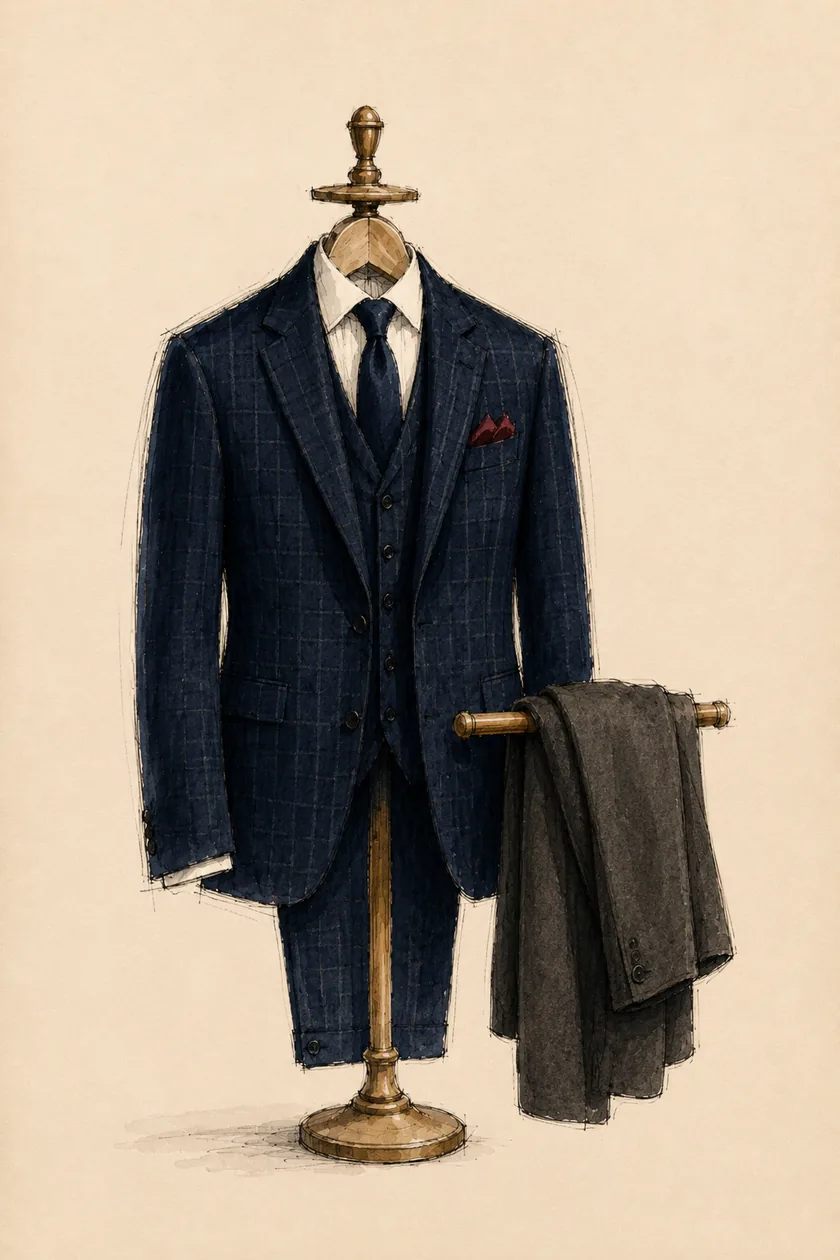
The grey glen check. A medium grey glen check with hints of blue, picked up by a blue lining, a sky-blue shirt with a spread collar and double cuffs, and a blue tie. The jacket has two buttons, slim notch lapels that stop well short of skinny, a long vent at each side and a single button at each cuff. The waistcoat has five buttons and a straight bottom. The trousers are flat-fronted, sit at a medium-high waist, and finish with a short break.
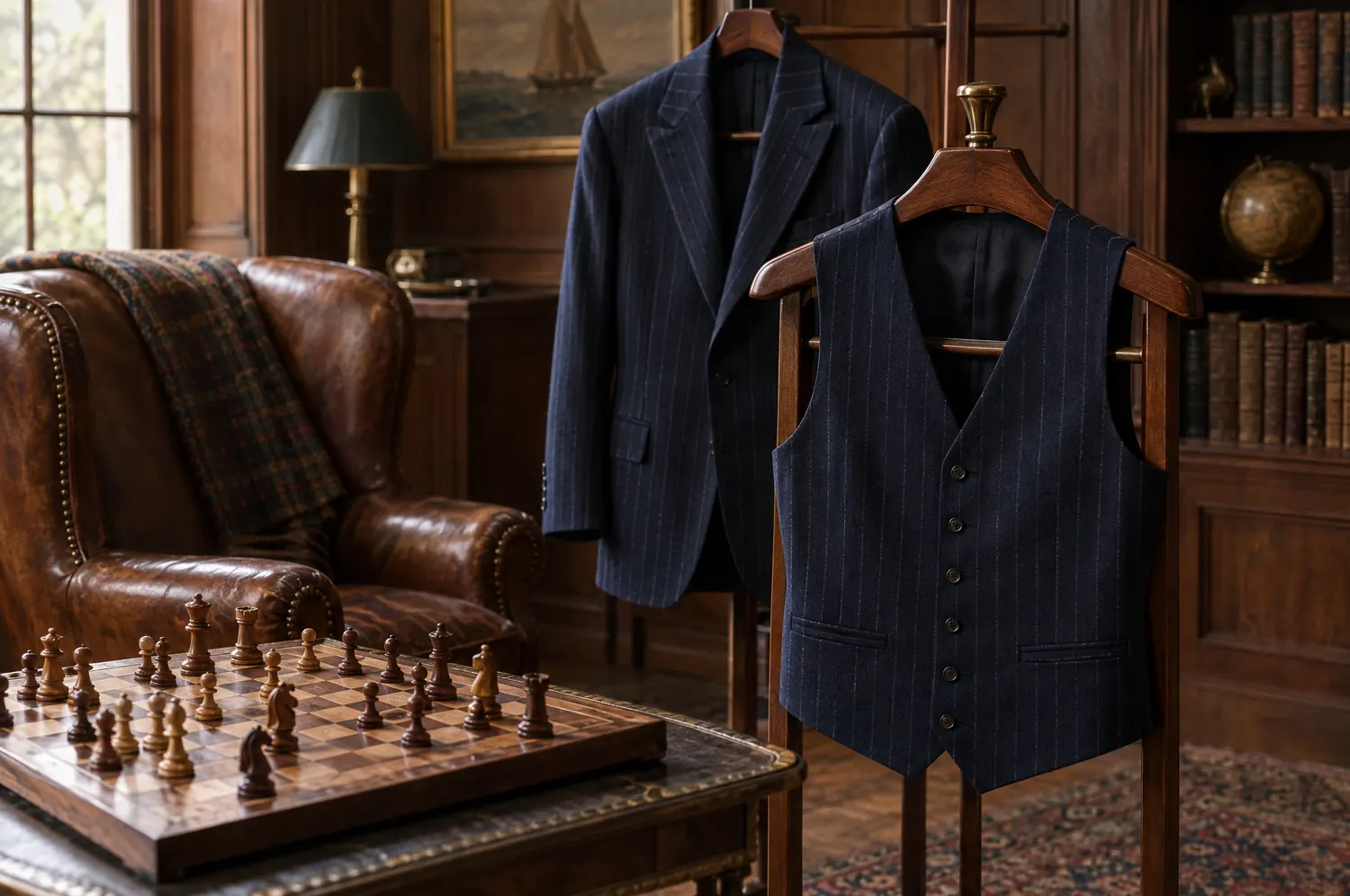
The navy chalkstripe. The business suit: dark navy worsted flannel with a white chalkstripe, two buttons, notch lapels, a single vent, a five-button waistcoat with a notched bottom, and flat-front trousers that are almost certainly on side adjusters rather than a belt. An ecru shirt with double cuffs and a navy tie.
There are more: a brown three-piece with a lapelled waistcoat, a solid grey with a straight-cut one, a navy with a double-breasted waistcoat. He is never seen in pleats.
What stays the same from suit to suit, and what changes?
The silhouette stays put: two buttons, slim notch lapels, a matching waistcoat, flat-front trousers sitting near the waist. The details move. One jacket has side vents, another a single vent; the waistcoats come straight, notched, lapelled and double-breasted. That is a more useful lesson than “wear the same suit every day”. Settle the shape once, then let the cloth and the details vary.
It is exactly how a kept pattern works. Once your measurements and pattern are on file, the next suit is cut from that same pattern in a new cloth, and things like the vents, the waistcoat style or the trouser finish become choices on the order rather than a fresh start. A reorder from a kept pattern takes two to three weeks.
Does a three-piece look stuffy, or like a groomsman?
It looks like a groomsman when the waistcoat differs from the suit: a shiny contrast waistcoat, a satin back on show, a waistcoat worn without its jacket at the head table. Crown’s waistcoats are cut from the suit cloth and worn under the jacket all day, in flannel and glen check, which are working cloths. That reads as a business suit with one more layer. Keep that rule and a three-piece looks deliberate in a Toronto office in February rather than borrowed from a wedding.
How should a waistcoat fit?
This is where most three-pieces go wrong, and it starts with the trousers.
- It must cover the waistband. A waistcoat over low-rise trousers leaves a strip of shirt, or a belt buckle, showing beneath it whenever you move. Crown’s trousers sit at a medium-high waist; yours need to sit high enough for the waistcoat to overlap them standing and sitting.
- No belt underneath. A buckle under a waistcoat makes a lump at the front. Side adjusters, as on Crown’s chalkstripe, or braces solve it; side adjusters or belt loops and belt or braces show both.
- The bottom button stays open on a waistcoat with a notched bottom. It is cut for that, and doing it up drags the front.
- Close, not tight. It should lie flat when you sit, without the buttons pulling. The strap at the back is for small adjustments, not for cinching in.
- It is fitted with the trousers on. The height of the trousers and braces decides the waistcoat’s length, so both are settled together at the fitting on the finished suit.
Which Crown suit should you start with?
For a Toronto office, the navy chalkstripe flannel. Flannel is soft, matte and warm, a cloth for October to March, and a waistcoat suits the same months. The grey glen check is the more versatile year-round choice in a worsted, and Goldfinger shows another famous one. In July, leave the waistcoat at home: a three-piece in summer is one layer too many. Three-piece or two-piece covers when the waistcoat earns its place, and four days on Bay Street works out how a few suits cover a working week.
Getting it made
Sam keeps every client’s pattern on file. The first suit takes three to four weeks with one fitting on the finished suit, measured at the Vaughan studio or at your office on request; after that the next one is a phone call and a cloth, made in two to three weeks. Orders placed between November 20 and the end of February take about three weeks longer, so a flannel for this winter is best ordered before November 20. Start with the navy chalkstripe: draw the Crown suit on the Drawing Board, then book the first appointment. How many suits a man needs covers what comes after it.
Where the details come from: BAMF Style on the grey plaid suit and on the chalkstripe.