Belt or braces: what your trousers were actually cut for
Updated August 2026 · Sam’s Menswear editorial team
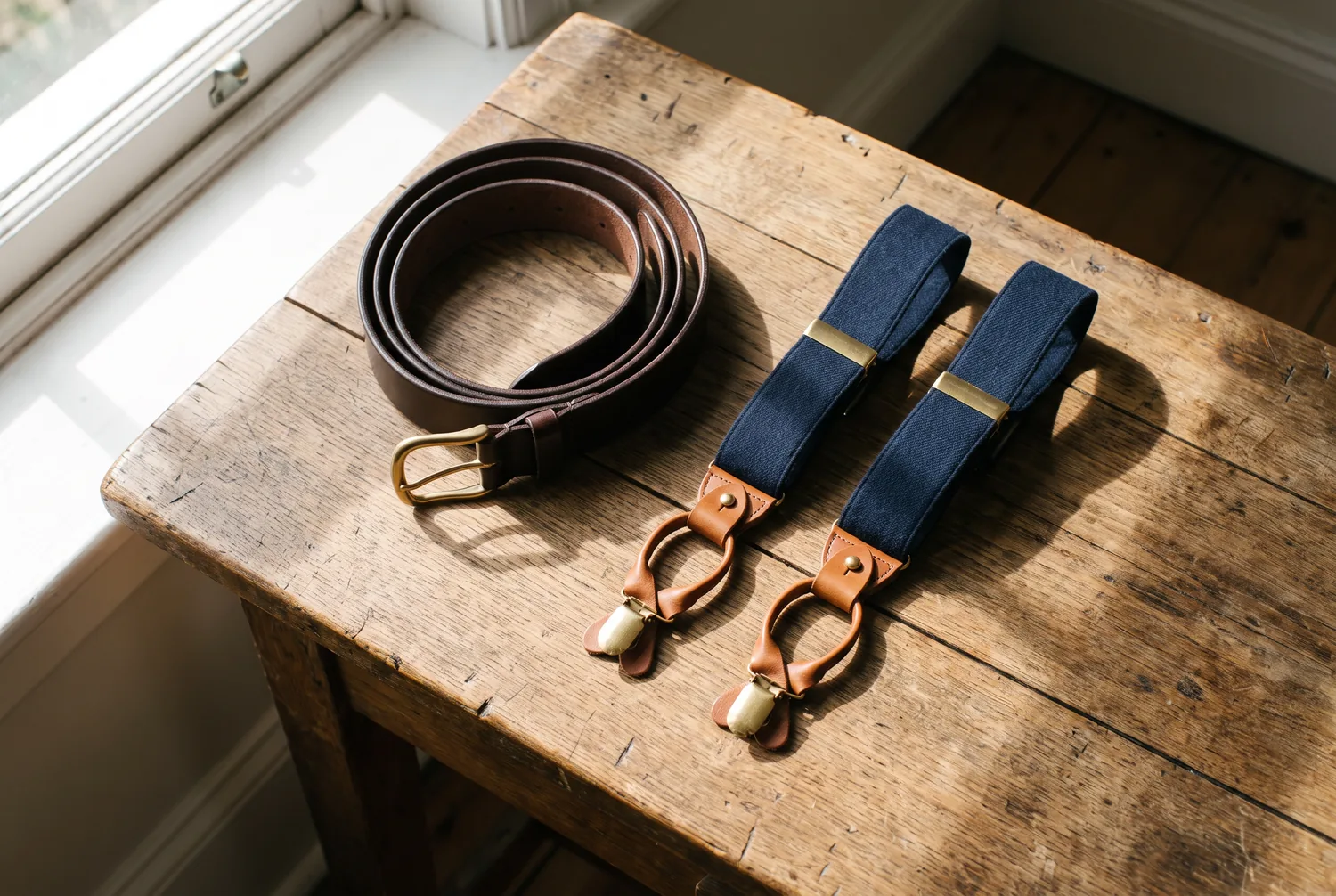
Most men have never chosen between these two. They wear a belt because trousers have loops, and trousers have loops because that is how they came. That is a fine reason for most days. It is worth knowing what the other option does, though, because on a suit the difference is visible from across a room.
What each one actually does
A belt holds your trousers up by squeezing your waist. That is the whole mechanism. It works, and it has worked for a hundred years, but it means the waistband has to be slightly tighter than your body, and cloth that is being squeezed does what cloth always does: it gathers. Look at the front of almost any belted trouser and you will see small creases radiating out from the buckle. That is the belt doing its job.
Braces hold your trousers up from your shoulders. Nothing has to grip. The waistband can sit exactly where it wants to and hang straight down from there, which is the line the trouser was cut to have.
That is the entire argument, and everything below it is detail.
The waistband will tell you which it was made for
Turn the trousers over and look at the waistband.
Belt loops and nothing else. Made for a belt. Wear one.
Buttons on the inside of the waistband, usually six of them, two at each side of the front and two at the centre back. Made for braces. These are almost always suit trousers, and often the buttons are there on trousers whose owner has never noticed them.
Side adjusters — small buckled tabs on each hip, sometimes called Daks tops. Made for neither. The trouser adjusts itself and wants no belt at all. Putting a belt through a side-adjuster trouser that also has loops is a common sight and it defeats the point of the adjusters.
Both loops and brace buttons. Some makers hedge. Pick one and commit for the day.
If your suit trousers have brace buttons and you have never used them, that is worth a try before you decide the trouser is the problem. A rise cut for braces often sits slightly higher than men expect, and it will feel wrong for the first hour and right after that.
What it does to the line
Here is the part you can see.
A trouser held by a belt has to be cut a little closer at the waist so the belt has something to work against. The waistband sits below the natural waist, and the front of the trouser breaks slightly under the buckle. With the jacket buttoned nobody sees any of it.
A trouser held by braces sits at the natural waist, which is higher — roughly at your navel rather than your hip bones. From there the cloth falls in one uninterrupted line to the shoe. There is no gathering at the front and no gap opening at the back when you sit down and stand up. On a suit, and especially on a suit with any drape to the trouser, it looks calmer.
The catch is that the higher rise only looks right if the jacket is long enough to cover the waistband. That is a question of proportion and it is why braces belong with a proper suit rather than with separates.
When to wear which
Braces — a full suit worn with the jacket on. Morning dress. Black tie, where a belt is simply not worn and the trousers will have brace buttons for exactly that reason. A wedding, where you are in the jacket all day anyway.
A belt — anything you will take the jacket off in front of people. Trousers worn as separates. Anything with a lower rise. Most working days for most men.
Neither — trousers with side adjusters, which is increasingly common on made trousers and is quietly the most comfortable option of the three.
The rules that are actually rules
Never both at once. Belt and braces together is a byword for redundancy in English for a reason. It also looks exactly as fussy as it sounds.
Clip-on braces will chew a good waistband. The clips bite into the cloth and leave marks that do not come out. If a trouser has brace buttons, use braces with leather runners and button them on. If it does not, and you want braces, a tailor can add the buttons in about ten minutes. It is one of the cheapest useful things anyone can do to a suit trouser.
Braces are not meant to be seen. They are underwear with a job. A man in shirtsleeves and braces has made a decision about how he wants to be looked at, and it is a bigger decision than he usually intends. If your day involves taking the jacket off, wear a belt.
Match the leather, not the elastic. If your braces have leather runners, those should be in the same family as your shoes and belt — see matching your leather. Nobody will see them. It is still the right way round.
A note on the belt itself
If you are wearing one with a suit, keep it quiet. A dress belt is narrower than a jeans belt, around 3 centimetres, with a plain buckle in brass or silver and no visible stitching contrast. The heavy 4-centimetre belt with a big buckle is a casual object and it reads as one under a jacket.
The other thing: buy the length properly. A belt should fasten on the middle hole of five, which leaves you room in both directions over the years. If you are on the last hole, the belt is too short and the tail sticking out past the first loop is telling everyone.
What we do about it here
Trousers made at the studio are cut for whichever you tell us. Brace buttons cost nothing to put in at the time of making and are a nuisance to add to a finished waistband that was not planned for them, so it is worth saying at the measuring rather than deciding later. Side adjusters are the same — decided at the start, awkward afterwards.
If you have a suit already and want the buttons added, bring it in. It is a ten-minute job and it does not touch anything else about the trouser.
Nobody has ever come to a fitting worrying about this. But once you have worn a suit trouser on braces for a day, the belted version does look like it is being held up, because it is.