Matching your belt to your shoes
Updated August 2026 · Sam’s Menswear editorial team
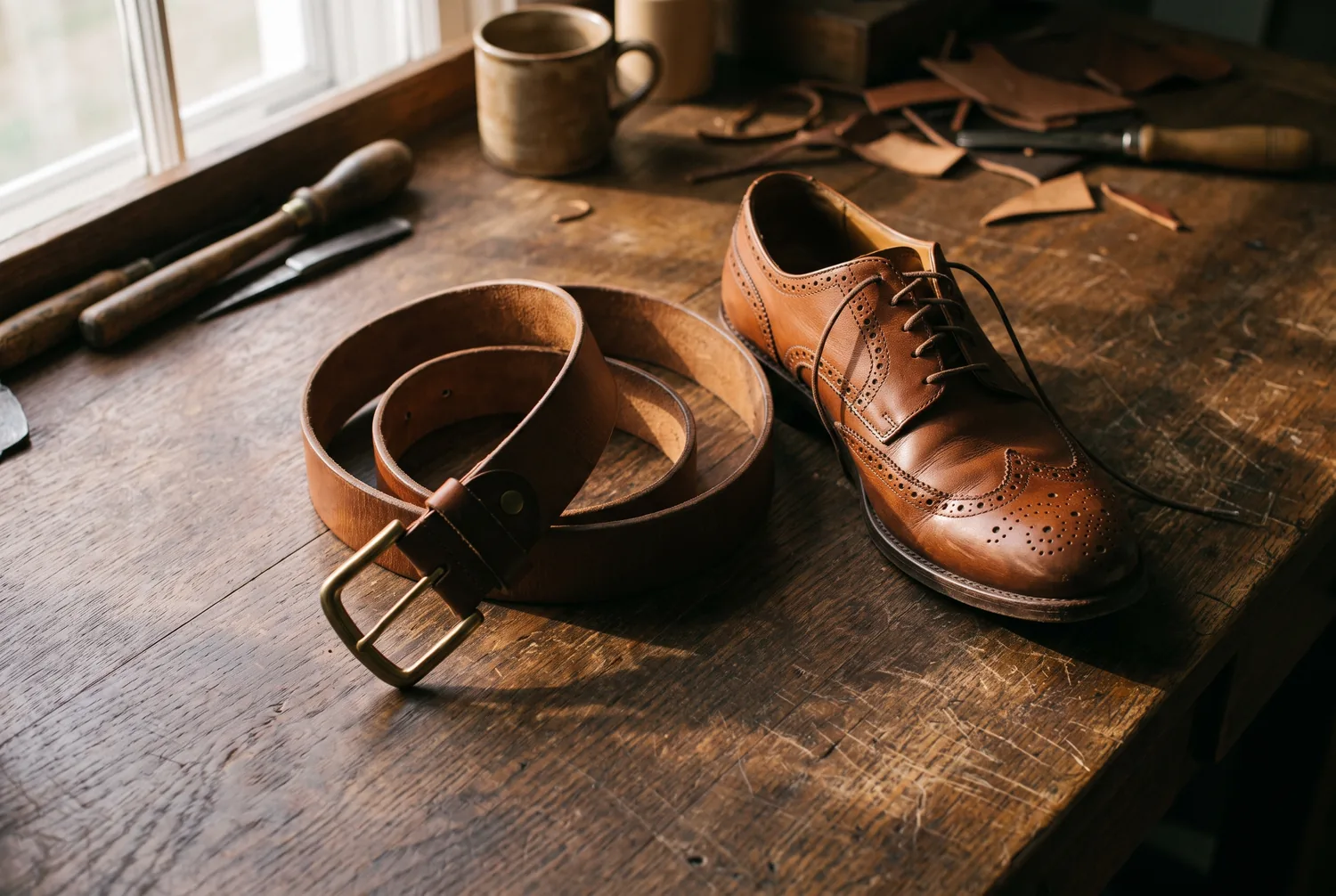
Of all the accessory rules men are handed, this is the one worth keeping. It is also the one most often over-thought, so it is worth saying exactly how far it goes.
The rule
Your belt and your shoes should be the same colour family. Brown shoes, brown belt. Black shoes, black belt.
That is it. That is the whole rule.
What “match” does not mean
It does not mean identical. It cannot, and chasing it is a waste of an afternoon.
Leather is a natural material that takes dye differently batch to batch, and it darkens as it ages and gets polished. A belt bought on the same day as a pair of shoes, in the same nominal colour, from the same maker, will have drifted apart within a year because one of them lives in a wardrobe and the other walks through Toronto winters.
More to the point: nobody can see them at the same time. Your belt is at your waist and your shoes are on the floor. An observer takes them in separately, several seconds apart, and what registers is the family — brown, black — not the exact shade.
So: same family, roughly similar depth. Dark brown shoes with a dark brown belt. Tan shoes with a tan belt. A mid-brown belt with dark brown shoes is entirely fine and nobody will ever notice.
What does register is a genuine mismatch. Black belt with brown shoes reads as an accident, because it is one. That is the only version of this that actually looks wrong.
The metal counts too
The buckle is the part of the belt people see, and it should agree with the other metal you are wearing.
Silver-toned buckle with a steel watch, silver cufflinks, a silver tie bar.
Gold or brass buckle with a gold watch, gold cufflinks.
Mixing gold and silver is a thing some men do deliberately and well, and it is a harder trick than it looks. If you are not doing it on purpose, pick one.
A wedding ring is exempt from all of this. Nobody expects a man to change his ring, and nobody has ever thought less of one for wearing gold on his hand and steel on his wrist.
The three most men forget
The watch strap. If it is leather, it is a piece of leather on your body and it plays the same game. Brown strap with brown shoes. A black leather strap with brown shoes and a brown belt is the most common version of this mistake, and it happens because a watch gets put on without being thought of as an accessory. A steel bracelet or a fabric strap sidesteps the question entirely.
The bag. A briefcase, a laptop bag, a weekend bag. It is the largest piece of leather you own and it is held right next to your body all day. It should be in the same family as the shoes. This one matters more than the belt, simply because of size, and it is the piece nobody thinks about.
Braces with leather runners. Nobody will see them under a jacket. They should still be brown with brown, because the day you take the jacket off, they are there. See belt or braces for which one your trousers actually want.
What if the shoes and the suit disagree
They cannot, really — the shoes answer to the suit and the belt answers to the shoes. The order is:
- The suit decides the shoe. (Navy takes brown, charcoal takes black — the reasoning is here.)
- The shoe decides the belt.
- The belt decides the buckle metal.
- The metal decides the cufflinks and the watch.
Work down that list and you never have to hold two things up against each other.
The belt itself, with a suit
Since we are here: a dress belt is narrower than a casual one, around 3 centimetres, in a smooth finished leather, with a plain rectangular or slightly rounded buckle and no contrast stitching. The wide belt with a heavy buckle belongs with jeans and looks like it under a jacket.
Buy it long enough to fasten on the middle hole of five. If you are on the last hole, the tail sticking out past the keeper is doing the announcing.
Two ways out of the question entirely
Side adjusters. Trousers with buckled tabs at the hips need no belt at all, and then there is nothing at your waist to match to anything. This is quietly the most comfortable option, and it is a decision made when the trouser is cut rather than afterwards.
Braces. Same effect — nothing at the waist. Correct with a full suit worn jacket-on, and required with black tie.
Both of those are worth raising at the measuring rather than after. Brace buttons and side adjusters are simple to build into a trouser and awkward to add to a finished one.
Where this actually falls apart
Not on the belt. On the shoes.
A man in a good suit with a decent belt and tired shoes has one problem, and it is not the belt. Shoes take the weather, the salt, and the whole weight of a person, and they show it faster than anything else worn. Two pairs alternated, cedar trees in them overnight, and a proper polish four times a year will keep a good pair going for a decade.
That is more return than any accessory decision on this page.