The pocket square, without the fuss
Updated August 2026 · Sam’s Menswear editorial team
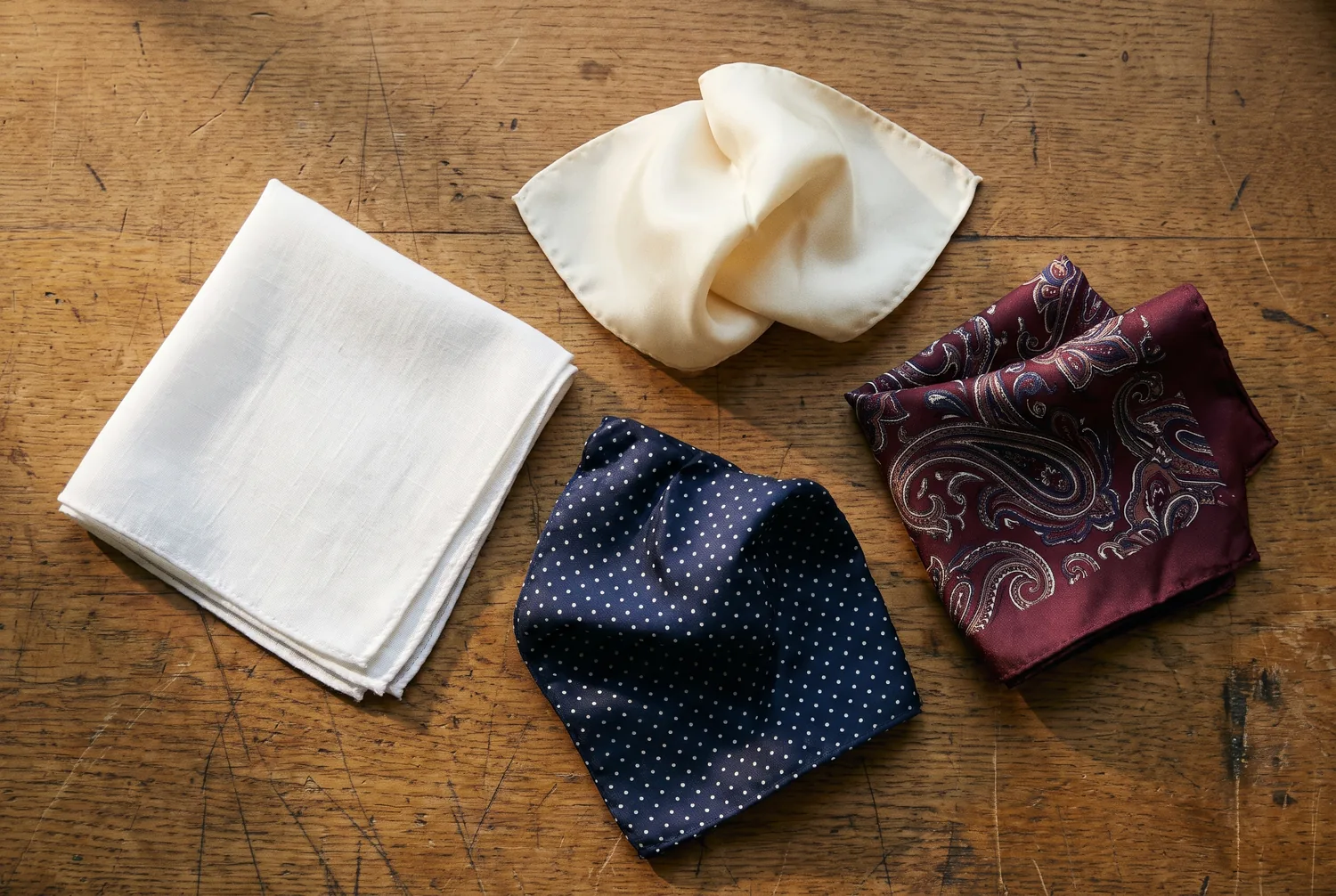
More men own a pocket square than wear one. It sits in a drawer because it feels like a flourish, and a flourish feels like a claim.
It is not much of a claim. A breast pocket with nothing in it is a small empty rectangle on the front of your jacket, and something in it finishes the jacket the way a hem finishes a trouser. Here is the smallest possible amount you need to know.
Buy this one first
A white linen square with a hand-rolled edge. About 40 centimetres.
It goes with every suit you own, every shirt, every tie, and every occasion including the sombre ones. It is right at a wedding, at an interview, at a funeral, and on an ordinary Tuesday. If you buy one thing from this page, buy that, and you may never need a second.
The hand-rolled edge matters more than it sounds. It is a slightly thicker, softly rolled hem rather than a flat machine stitch, and it gives the square enough body to hold its shape in the pocket instead of sliding down and disappearing by lunchtime.
Linen over silk for a first square, because linen holds a crease and silk does not. That single property decides which fold you can do.
The fold that covers almost everything
The flat fold. Sometimes called the presidential.
- Lay the square flat and fold it in half, then in half again, so you have a smaller square.
- Fold it once more so its width is slightly less than the width of your breast pocket.
- Fold the bottom up so the whole thing is about as tall as the pocket is deep.
- Slide it in with the clean folded edge facing up.
- Let one centimetre show above the welt. No more.
That is it. A quiet white line across the top of the pocket. It reads as considered rather than decorative, and it is impossible to overdo.
The most common error is height. Three or four centimetres of square standing up out of a pocket stops being a detail and becomes a feature, and a feature has to be earned.
The other fold worth knowing
The puff. For silk, which will not hold a crease.
Pinch the square in the middle, lift it, let the corners fall, gather the loose bottom into your fist, and post it into the pocket with the soft rounded gather showing. Adjust with a fingertip. It takes ten seconds and it looks slightly different every time, which is the point.
Silk is dressier and less serious than flat white linen. It suits a wedding, a dinner, a party. It is wrong at a funeral, where the flat white fold is the only correct answer.
Every other fold — the multi-point crown, the elaborate ones with four peaks standing up — is a decision to be looked at. There is nothing wrong with that if it is what you want on the day, but it is not a default, and at a business meeting it puts your handkerchief ahead of your argument.
The one real rule
Never match your tie.
A square in exactly the same fabric and pattern as the tie looks bought as a set, because it was. It tells everyone that the decision was made at a till rather than in front of a mirror, and it flattens the outfit into two identical patches of the same thing.
What you want instead is a square that picks up something already in the outfit without repeating it. A burgundy tie and a square with a thread of burgundy running through a different pattern. A navy suit and a square with a navy edge on white. The eye notices the relationship and does not notice the effort.
The safest version of this is white linen, which relates to the shirt and therefore relates to everything.
What to own, in order
- White linen, hand-rolled. Covers everything.
- A second white or off-white, so one can be in the wash.
- A navy or burgundy silk with a small pattern, for occasions with some colour in them.
- Then whatever you like, because at this point you are past the useful part and into the enjoyable one.
Four squares is a lot of pocket squares. Two is enough for most men’s whole lives.
The pocket itself
Worth knowing, since it decides how the square behaves.
A welted breast pocket — the standard flat one — holds a flat fold cleanly. A barchetta, the gently curved boat-shaped breast pocket found on softer Italian tailoring, is shallower and shows the square at a slight tilt, which suits a puff better than a flat fold.
Neither is better. But if a jacket is being made and you actually intend to wear squares, it is worth saying so, because the depth and shape of that pocket are set once and never adjusted afterwards.
Most men never mention it. It takes one sentence at the fitting and it is the difference between a square that sits where you put it and one that sinks out of sight by the second hour.