The tie: width, knot, and where it should end
Updated August 2026 · Sam’s Menswear editorial team
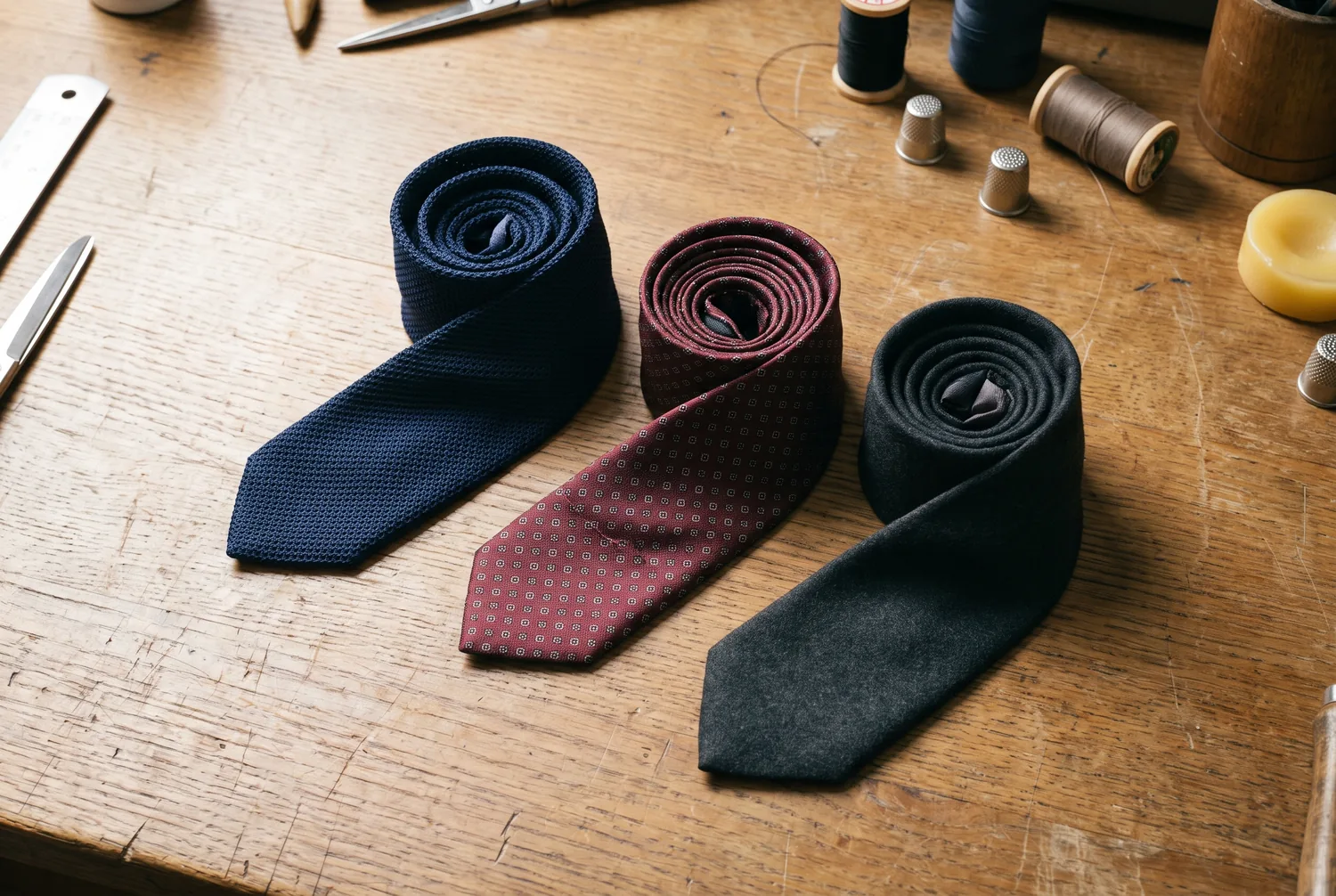
A tie is the one thing in an outfit a man chooses purely because he likes it, which is why it is also the piece most often slightly wrong. The pattern is the part everyone thinks about and the least important of the three things that actually decide whether it looks right.
1. Width
The tie should be about as wide as your lapel. That is the whole rule, and it is the one men break most.
Look at the widest point of your jacket lapel and the widest point of the tie blade. They should be near enough the same. Most modern suits have a lapel somewhere between 8 and 9 centimetres, so most ties should be too.
When they disagree, everything looks slightly off and nobody can say why. A skinny 5-centimetre tie against a broad lapel looks like it wandered in from another suit. A wide 10-centimetre tie against a narrow lapel looks like it was inherited, which sometimes it was.
The useful consequence: buy ties at around 8.5 centimetres and they will go with almost every jacket you own now and most of the ones you buy later. Very narrow and very wide ties both date fast, because they belong to a specific decade and announce it. The middle does not.
2. Length
The tip of the tie should finish in the middle of your belt buckle.
Not above it, which looks short and slightly comic and is what happens to tall men who buy standard ties. Not below it, which looks careless and is the more common fault.
The rear blade should sit shorter than the front one and hook into the keeper loop on the back so it stays there. If your back blade hangs below the front, tie it again — that is a tying problem, not a length problem.
If you are over about six foot two, standard ties will run short on you, and the answer is an extra-long tie rather than a smaller knot. Trying to fix length with the knot is how men end up with a four-in-hand on a spread collar that needed something fuller.
3. The knot
There are four worth knowing and really only two you need.
Four-in-hand. Small, slightly asymmetrical, tapered. The default. It suits a point collar or a narrow spread, it works with thicker ties like wool or grenadine, and its slight lopsidedness is a feature rather than a flaw — it reads as hand-tied rather than manufactured.
Half Windsor. Larger, symmetrical, triangular. This is what a wide spread collar wants, because a small knot inside a wide spread leaves two triangles of bare shirt on either side and the collar looks like it is falling open.
Full Windsor. Big and very symmetrical. It needs a genuinely wide spread collar and a thin tie to work, and outside that it overwhelms. Most men who wear one are wearing it in a collar that cannot hold it.
Pratt / Shelby. Between the four-in-hand and the half Windsor. Perfectly good, almost nobody uses it.
The way to choose is to look at your collar, not at a chart. Narrow gap between the collar points: small knot. Wide gap: bigger knot. The knot should fill the space between the collar points without wedging them apart.
The dimple
Under the knot, in the middle of the blade, there should be a single vertical crease.
You make it by pinching the blade just below the knot as you pull it tight, so the fabric folds in on itself rather than lying flat. It takes two attempts to learn and then you do it without thinking.
It matters because it makes the tie sit forward off the shirt and catch light down its length, and because a flat, dimple-less knot reads as a clip-on even when it is not. It is the single detail that separates a tie that was put on from one that was tied.
Knitted ties and very heavy wool ties do not take a dimple. That is fine — nobody expects one there.
Texture, and why grenadine keeps coming up
Once the width, length and knot are right, texture does more work than pattern.
Grenadine is a silk woven on an old-fashioned loom into an open, gauzy structure. Solid colour, but the weave catches light unevenly so it never looks flat, and it goes with absolutely everything. A navy grenadine is the most useful tie a man can own and it is worth more than four patterned ties.
Wool and cashmere are matte and soft, right for autumn and winter, right with flannel and tweed, and wrong with a sharp worsted suit in July.
Printed silk — the classic patterned tie. Smooth and slightly formal.
Knitted silk, with its flat square end, is the most casual of the lot. Good with a blazer, not with a business suit.
If you own three ties: navy grenadine, a burgundy with a small quiet motif, and a charcoal or brown wool for winter. That covers a working year.
Where it sits with everything else
The tie has to agree with the shirt and the jacket in pattern scale, which is a subject of its own — mixing patterns has its own guide. And the colour question comes back to your own colouring rather than to the suit: which colours actually suit you.
The bit about the lapel
One thing worth saying, since it is the half of the width rule you can actually control.
When a jacket is made here, the lapel width is a choice, and it is one most men never realise they get to make. Wider lapels suit a broader man and a double-breasted; narrower suit a slighter frame. Whatever gets chosen, it sets the tie width for the life of the jacket — so it is worth mentioning at the fitting if you already own ties you love.
Nobody thinks to bring a tie to a first appointment. The men who do end up with a jacket that agrees with their whole drawer.