How a dress shirt should fit: the seven places it is right or wrong
Updated August 2026 · Sam’s Menswear editorial team
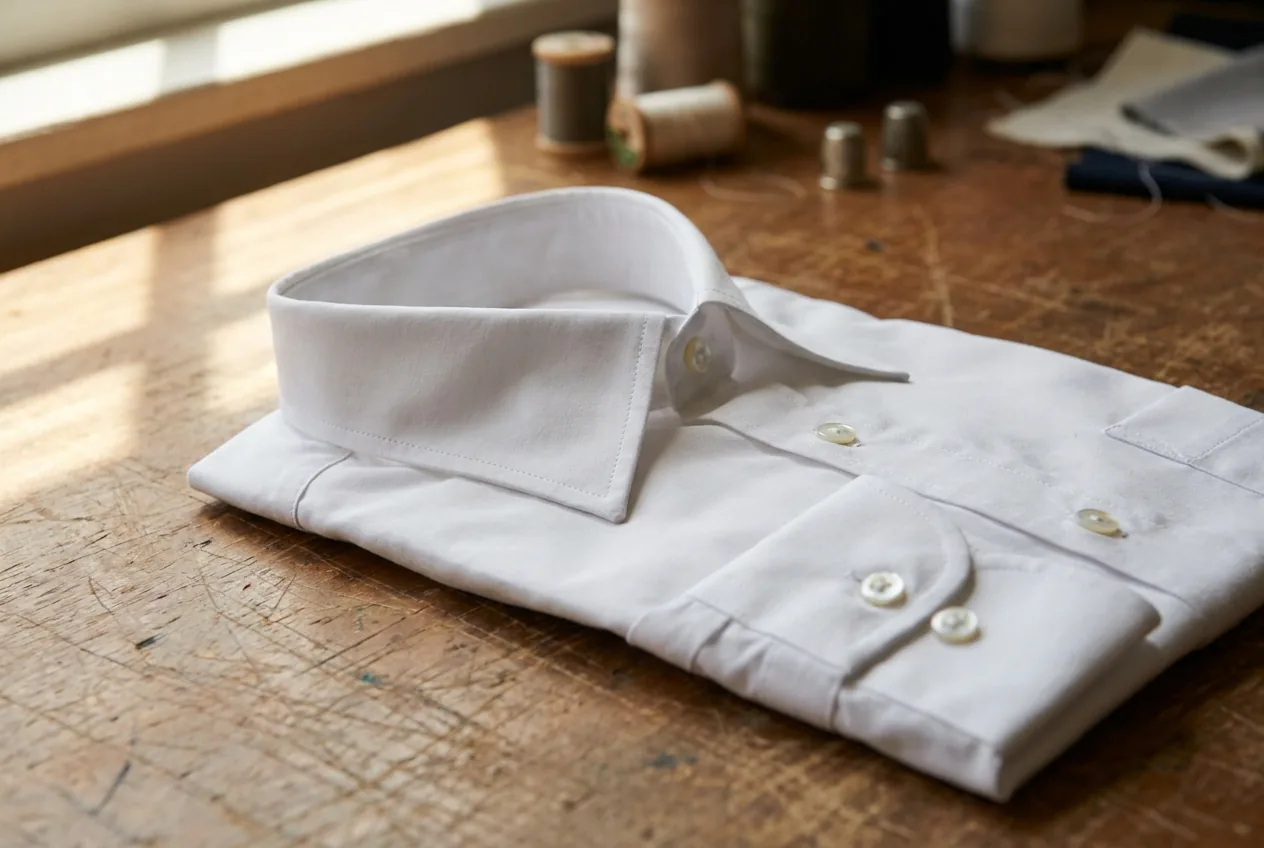
Most men judge a shirt by whether it tucks in and buttons up. That is the wrong test. A shirt is a close garment, worn against the body all day, and it announces its faults more loudly than a jacket does, because a jacket hides its own mistakes and a shirt has nowhere to put them.
There are seven places a dress shirt is right or wrong. Two of them cannot be fixed after you buy. The other five can, and knowing which is which changes what you should be fussy about.
1. The collar
Button it. Fasten the top button, the one you have been avoiding, and put two fingers flat inside the band.
Two fingers should slide in without a fight. One finger means it will choke you by two in the afternoon, when your neck swells slightly, as everyone’s does. Three fingers means the collar will stand away from you, and once it does, the tie knot sits in a gap and the whole outfit looks borrowed.
The band should sit against the neck the whole way round, not just at the front. Turn your head. If the collar stays put and your neck turns inside it, it is loose.
This is the one that cannot be fixed. A collar can occasionally be let out a half size by a good hand, but the shape and the roll are built into it, and a collar that was cut wrong stays wrong. It is the first measurement taken and the last one to forgive an error. If your collars have got tight since you bought them, see why the neck goes first.
2. The shoulder and the yoke seam
Stand square in front of a mirror. Find the seam that runs across the top of your back and down onto each arm. Where it turns down, that corner should sit exactly on the bony point of your shoulder.
Past it, and the sleeve hangs off a false shoulder. You get a soft fold under the armhole and a sleeve that twists when you reach. Short of it, and the armhole binds and the shirt pulls out of the trousers every time you lift your arms.
Most men have one shoulder lower than the other, usually the writing hand. On a made shirt that is simply drawn into the pattern. Off the rack it means one sleeve always looks slightly long, and men spend years thinking the problem is the sleeve.
This one cannot be fixed either, not properly. Re-cutting a yoke means taking the shirt apart. It is the reason a shirt that fits your shoulders and is loose everywhere else is a better buy than the reverse.
3. The chest
Do up every button and take a normal breath. The shirt should sit close but not pull. You are looking for the button placket to stay straight and flat.
The tell is the gap. If the buttons pull into small horizontal creases, or worse, if a gap opens between two buttons at chest or stomach height, the shirt is too tight through the body. That gap is the single most common fault on a shirt bought off a rack by a man with a chest, and no amount of tucking will hide it.
The opposite fault is quieter. Too much room through the chest reads as sloppiness rather than tightness, and it shows most when you take a jacket off.
4. The waist and the back
Turn sideways. There should be shape through the waist, following yours, without the shirt gripping.
The failure most men live with is billowing: a shirt cut straight from chest to hem, so that when it is tucked in there is a bolt of surplus fabric bunched around the waistband. It ruins the line of the trousers and it makes a thin man look heavier than he is.
The other direction is worse in a shul or a boardroom. Pulled too tight through the back, a shirt strains across the shoulder blades every time you lean forward, and it will wear out at the seam long before the fabric is finished.
This is fixable. Taking in the back and the side seams on a shirt you already own is straightforward, and it is the single alteration that most improves a shirt bought off the rack.
5. The sleeve
Let your arms hang. The sleeve should be full enough to move in and clean enough not to twist.
Look at the fold that runs down the back of the arm. If it spirals, the sleeve is set wrong or the armhole is too low. A low armhole is the reason a shirt lifts out of your trousers when you raise your arm: the whole shirt has to move because the sleeve cannot.
A higher armhole feels tighter for the first ten minutes and then disappears, and you can lift your arms without the shirt following.
6. The cuff
This is where a shirt does its most visible work, because it is the part your jacket puts on display.
The cuff should be snug enough that the shirt does not slide over your hand when you reach for something, and loose enough to take a watch. The test: with the cuff buttoned, the shirt should not pull down past the base of your thumb when you extend your arm, and it should not need unbuttoning to get your hand through.
Sleeve length is measured to the cuff, and the cuff should end where your hand begins, at the wrist bone, so that a quarter to half an inch shows beyond the jacket sleeve. Both wrists get measured, because most arms are not the same length.
Fixable, within limits. Shortening a sleeve is routine. Lengthening one is not, because the fabric is not there.
7. The length
Sit down. Then reach up. Then check the mirror again.
A dress shirt has to stay tucked through all of that. Too short and it works loose during the day, which is why men fidget with their waistbands. Too long and there is surplus fabric bunching at the seat.
If you wear a shirt untucked at times, that is a different length entirely and should be cut as such rather than hoped for. The hem of an untucked shirt wants to finish around the middle of the trouser fly, and a tucked-shirt tail worn out looks exactly like what it is.
The two faults nobody tells you about
Shrinkage. Cotton moves. A shirt that fits perfectly in the shop and then chokes you after four washes was cut without allowance, or washed too hot. Anything cut here is allowed for, and the fabric is chosen knowing it will be washed weekly for years, which matters more on a white shirt than on anything else in the wardrobe. There is a fuller account of that in the white shirt guide.
Posture. A man who stands with a forward head, or with one shoulder dropped, or who carries weight in front, does not need a bigger shirt. He needs a different balance between the front and the back of the pattern. This is the reason a man can buy his exact measured size and still find the collar riding up his neck at the back.
What this means when a shirt is made for you
Every point above is a measurement taken rather than a compromise accepted. The neck and the shoulder are drawn to you, so the two unfixable faults never arise. The waist is shaped to yours rather than to an average. Each cuff is set to its own wrist.
The pattern is then kept on file, which is the part men underestimate. The first shirt is the work; the second is a phone call. Most men order one, wear it beside the ones they own, and then reorder in threes.
Sam measures and fits every shirt himself at the Vaughan studio, and the fitting happens on the finished garment, so what you try on is the shirt. Shirts take two to three weeks. Alterations are part of the order.
If you want to know what to bring and what happens in the room, what to bring to your first fitting covers it. If you are choosing fabric, choosing your fabric is the place to start, and fabric for Toronto seasons deals with the specific problem of a humid July and an overheated February office.
And if the shirts are for a suit rather than on their own, how a suit should fit is the companion to this one: the quarter-inch of cuff that shows below a jacket sleeve is the place the two garments are judged together.