Side adjusters or belt loops? Trousers drawn side by side
Updated September 2026 · Sam’s Menswear editorial team
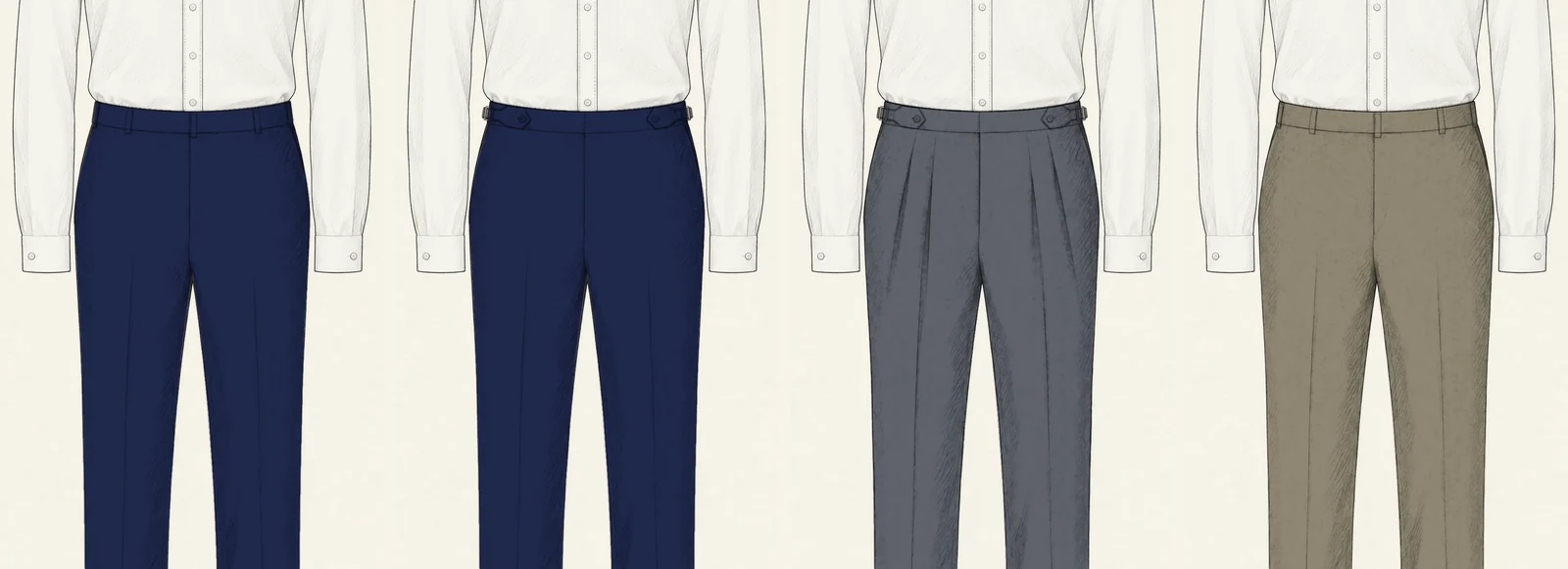
Trousers have to be held up somehow, and the waistband decides how. Belt loops take a belt. Side adjusters are small tabs at each hip that tighten or loosen the waistband on their own, so the trousers need no belt at all. The third way, braces, gets its own guide: belt or braces.
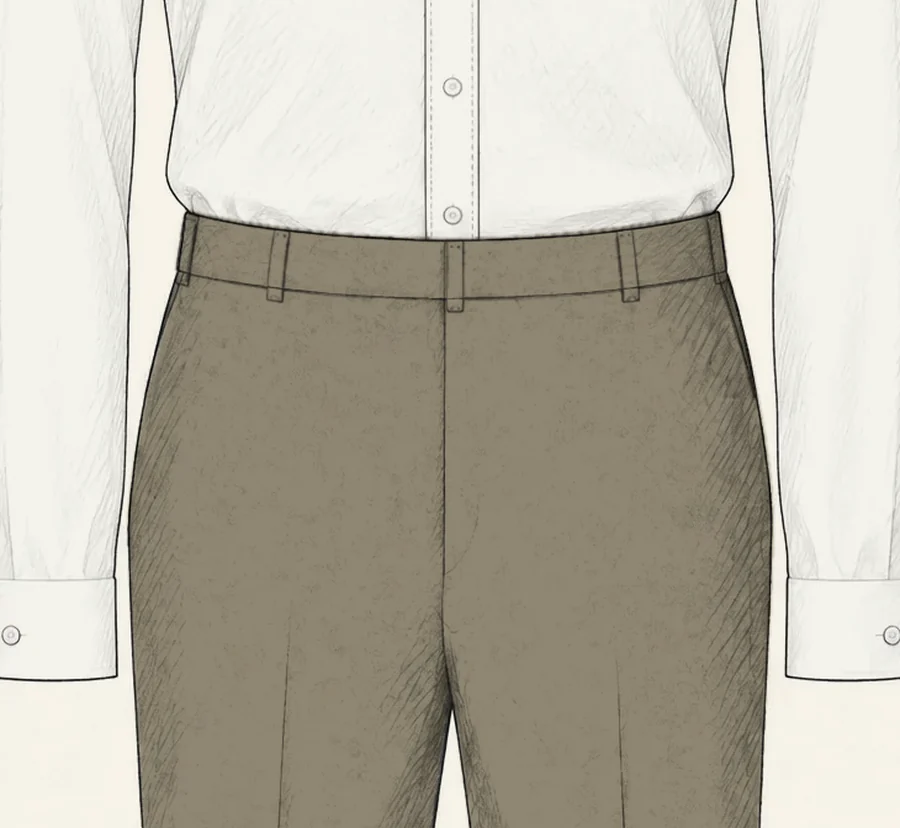
The drawings are the same navy trousers on the Shirt Board, with loops and with adjusters.
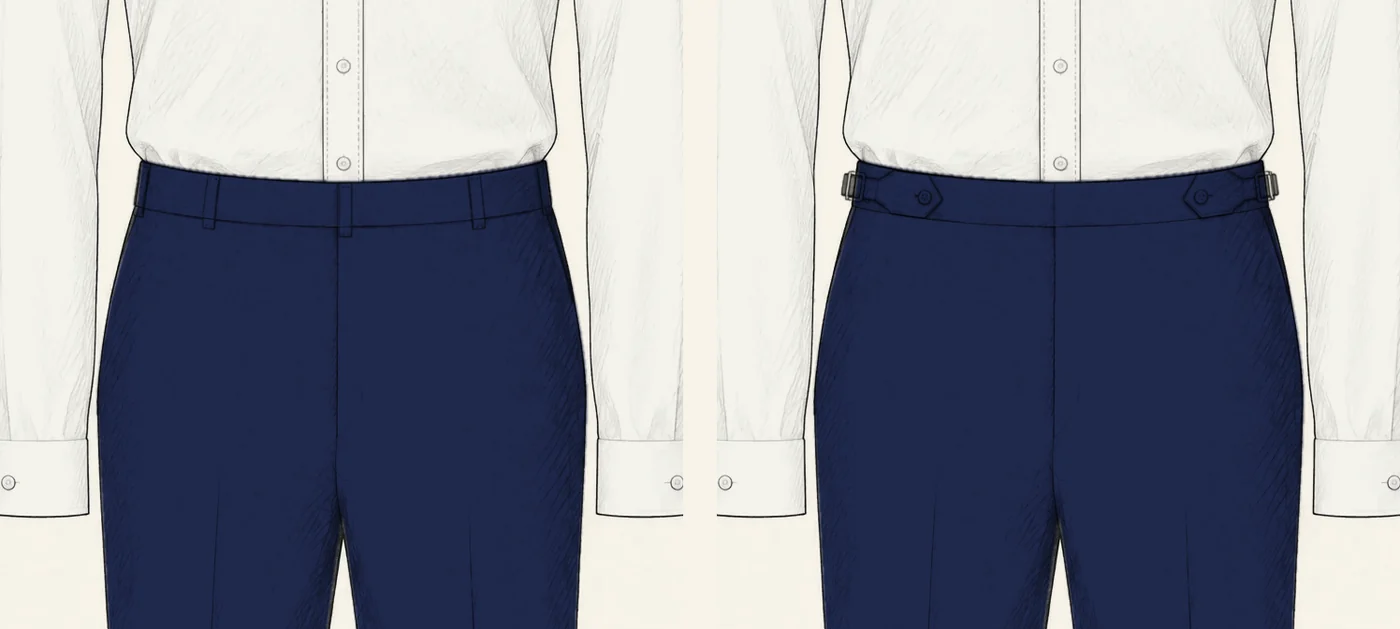
What side adjusters are
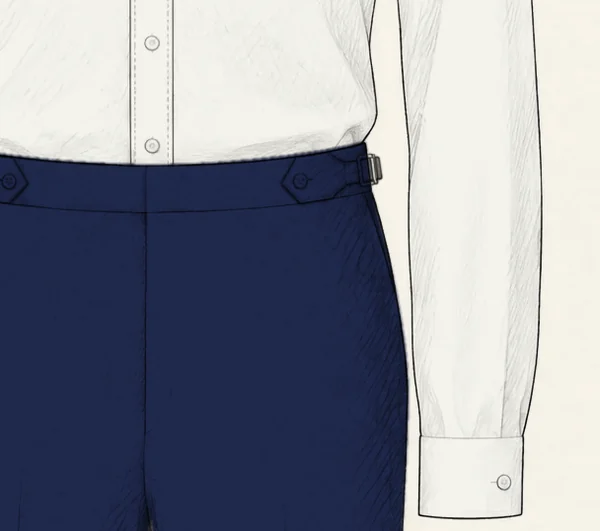
A side adjuster is a short tab on each hip, buttoned at the front and running back to a small metal buckle at the side seam. Pull the tab through the buckle and the waistband takes in; let it out and it gives. Some are plain buttoned tabs with a choice of buttonholes instead of a buckle. Either way they move the waist by an inch or so, and you will sometimes hear them called Daks tops.
They fine-tune a waistband; they don’t replace one that fits. The trousers still have to be cut to your waist, and the adjusters take care of the difference between a Monday morning and a long lunch.
What adjusters do better
- A clean line. No belt, no buckle, no loops: the waistband runs unbroken around you, and the trousers hang straight from it. Under a waistcoat there is no bump.
- Comfort. Nothing squeezes your waist, so the waistband doesn’t gather into small creases the way a belted one does.
- A waist that changes. Adjusters let out by an inch in a second, without unbuckling anything. After a large meal, through a fast, over a long Yom Kippur: it is the single best answer to a waist that is not the same all day. If your waist has changed for good, see trousers for a bigger belly.
- Nothing to match. No belt means no leather to match to your shoes. See matching your leather.
- Dressier. Adjusters are the tailored finish, and they look neat with the jacket off too, which braces don’t.
What belt loops do better
- They are familiar. Most men have worn a belt every day of their lives, and a pair of trousers with loops needs no explaining.
- Casual trousers. Chinos, linen and cords look right with a belt, and the belt adds a little colour and leather at the waist.
- A lower rise. A belt holds a trouser that sits on the hips; adjusters want a waistband at the natural waist.
- More range. A belt covers a few inches between its holes. Adjusters cover about one.
Don’t mix them
Some trousers have loops and adjusters both. Choose one: a belt through adjuster trousers holds the waist at the buckle and defeats the adjusters. Adjusters and brace buttons, on the other hand, go together well: the adjusters on most days, braces when you want them.
At a glance
| Belt loops | Side adjusters | |
|---|---|---|
| Held up by | A belt | Tabs and buckles on each hip |
| The line | Broken by the belt and buckle | Clean, unbroken waistband |
| Adjusts | A few inches, a hole at a time | About an inch, any time |
| Formality | Everyday, casual | Tailored, dressier |
| Rise | Any, including low | At or near the natural waist |
| Best for | Chinos, linen, jacket-off days | Suit trousers, three-pieces, black tie, flannels |
Which trousers want which
- Suit trousers: adjusters, especially under a waistcoat, where a belt makes a bump. Goldfinger made the case in 1964.
- Black tie: adjusters or braces, never loops. A belt has no place with a dinner suit.
- Odd trousers in flannel or worsted: adjusters for the cleanest line; loops if you like wearing a belt.
- Chinos, linen and casual trousers: loops.
- The High Holidays: adjusters, if you fast. Ask for them, and say why.
Decide at the order
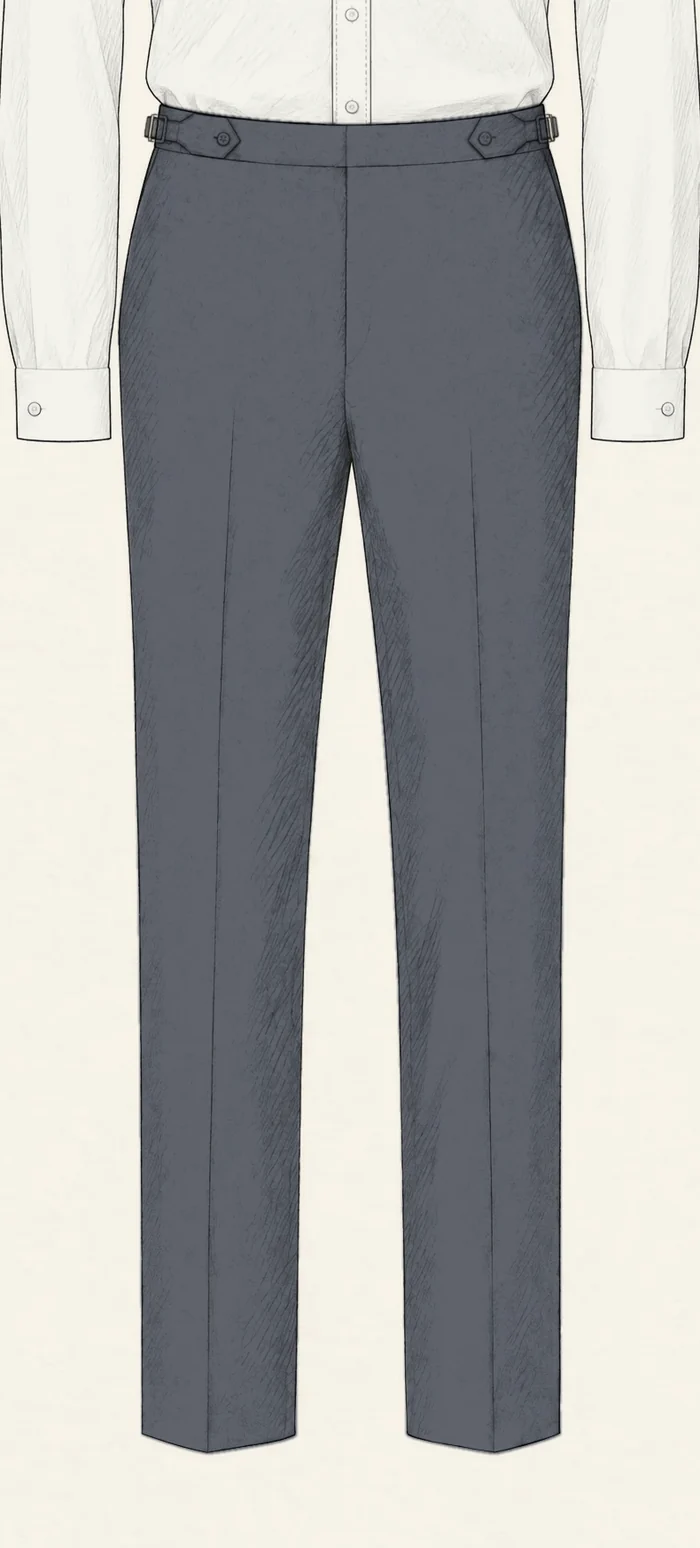
Adjusters are built into the waistband, and adding them to a finished pair is awkward. The same goes for brace buttons. Tell Sam at the measuring which you want, and if you fast or your weight moves, say so: it changes how the waist is cut.
Draw both
On the Shirt Board you can put trousers under any shirt and switch between belt loops and side adjusters, flat-front or pleated, plain hems or turn-ups: belt loops, side adjusters, grey flannel with adjusters. Send the drawing to Sam and the appointment starts from it.
Sam makes trousers with a suit or on their own, at his studio in Vaughan. A suit takes three to four weeks, with one fitting on the finished garment. Once your pattern is on file, another pair of trousers is a phone call: two to three weeks, no fitting needed.