Trousers for a bigger belly: rise, pleats, braces, and the belt that rolls under
Updated September 2026 · Sam’s Menswear editorial team
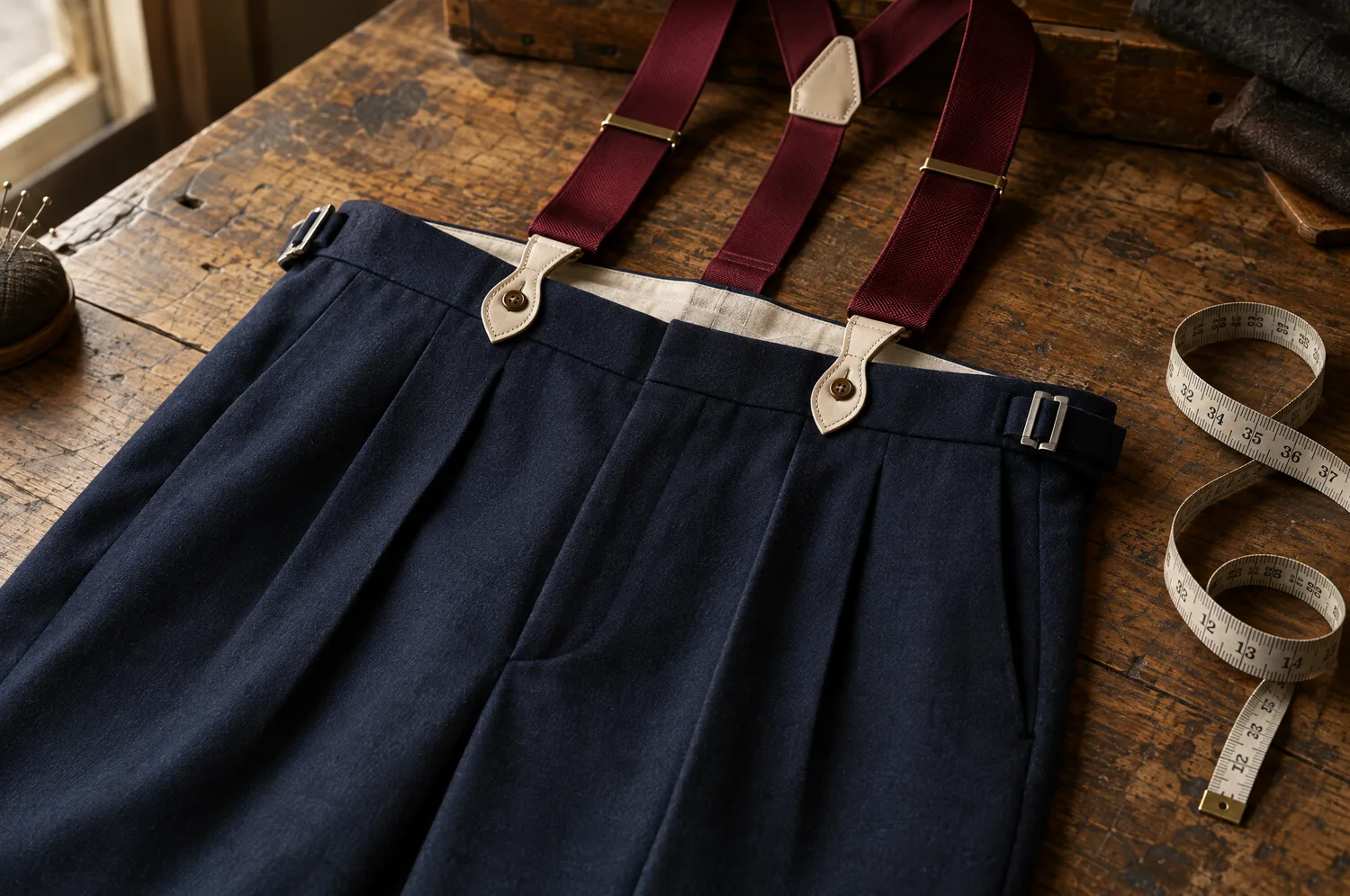
There’s a sequence most men know without having a name for it. The trousers are fastened in the morning at the right height. By lunch the belt has slid under the stomach. By the afternoon the back of the waistband has dipped, the seat sags, the crotch hangs lower than it should, and the hems are dragging under the heels. You hitch them up. It happens again.
This isn’t about being careless or about buying the wrong size. It’s geometry.
Why the belt rolls under
A belt works by gripping your body at its narrowest point. On most frames that’s the natural waist, roughly at the navel. When weight comes on at the stomach, the narrowest point moves: the body gets wider below where the belt sits. A belt on a slope does the only thing it can and slides down to where the circumference is smaller, under the belly.
Everything else follows from that. The waistband now sits lower at the front than at the back, so the back pulls down to meet it. The rise, measured for a waistband at your waist, now starts several inches lower, so the crotch drops. And the legs, cut for a fixed length from the waist, are suddenly too long.
Letting out the waistband doesn’t fix this, which surprises people. The trousers are no longer too small; they’re sitting in the wrong place. The fix is to make them sit where they were meant to.
Fix one: a higher rise
The rise is the distance from the crotch to the top of the waistband. Low-rise trousers, the kind most shops have sold for twenty years, sit on the hips below the navel, which is exactly the spot a bigger stomach takes away from you.
A higher rise brings the waistband up to your natural waist, above the widest part of the stomach. Up there the waistband holds by itself, the front lies flat over the belly instead of cutting under it, and the trousers fall straight from the waist rather than from under it. With a jacket on, nobody sees where the waistband is; they see a clean line from the jacket’s button to the shoe.
The front rise often wants extra length as well as height. Trousers cut with a little more length at the front, from the waistband down to the crotch, lie smoothly over the stomach without pulling into the creases that curve up from the fly like a smile. This is a matter of how the trousers are cut, not something that can be let out afterwards.
Fix two: forward pleats
Pleats are folds of cloth at the front of the trousers, just below the waistband. Flat fronts have been the default for a generation, but they leave no spare room for the moment you sit down, which is when your waist and hips get bigger.
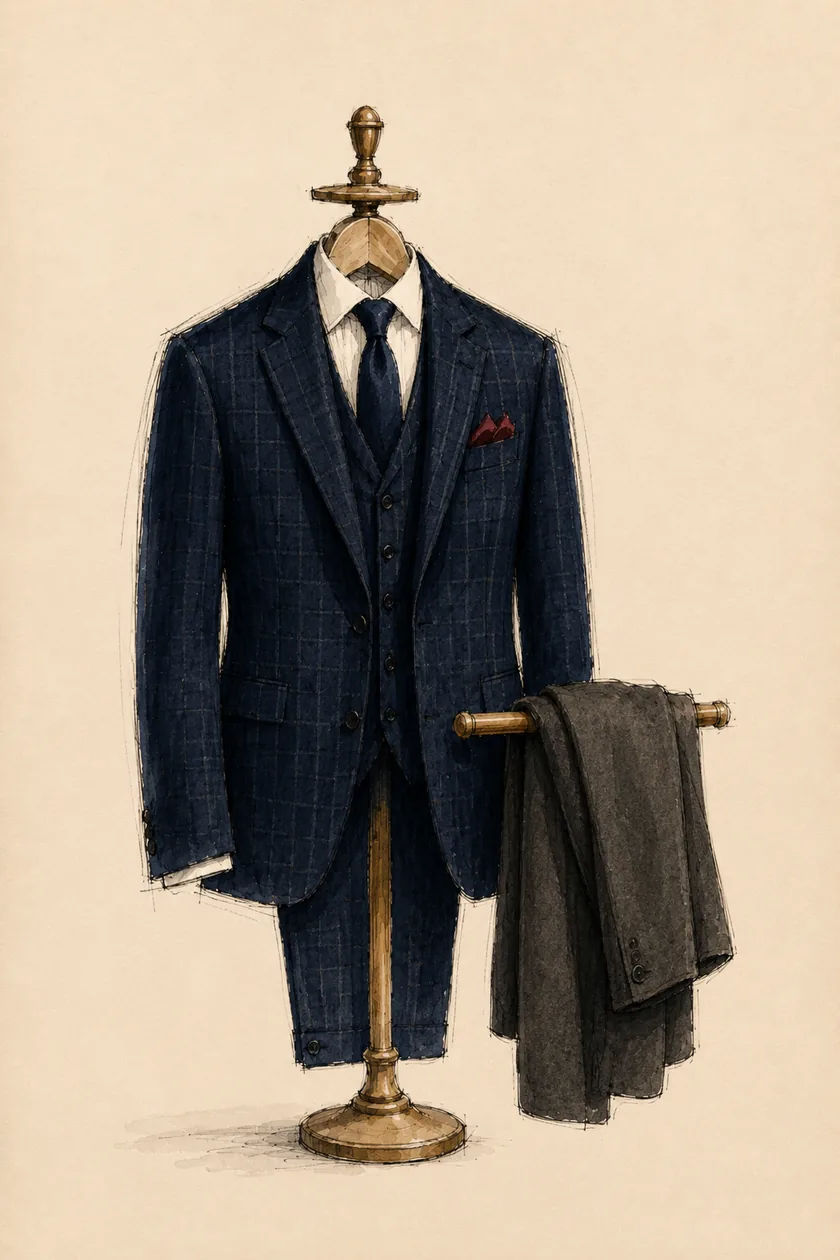
A pleat opens when you sit and closes when you stand. Forward pleats, which face in towards the fly, give room over the stomach and the tops of the thighs and lie flatter when you’re standing. One pleat on each side is usually plenty. You can see the difference drawn before you choose.
Fix three: adjusters or braces instead of a belt
A belt has to be cinched tight to hold trousers up, and a tight belt under a stomach is uncomfortable and slides anyway. Two alternatives hold trousers without a cinch.
Side adjusters are small buckled tabs on each side of the waistband. They take in or let out about an inch without a belt, so the waistband fits comfortably at breakfast and still fits after dinner. They also mean no belt buckle pressing into your stomach when you sit. More in side adjusters vs belt loops.
Braces (suspenders) hang the trousers from your shoulders instead of gripping your waist. The waistband sits at the height you set and stays there all day, however your stomach moves, and the trousers can be cut with a little ease at the waist because nothing is holding them up by squeezing. Braces button inside the waistband, so they’re decided when the trousers are made. Traditionally, trousers for braces are often cut a touch higher at the back, so they don’t dip when you sit.
Braces are hidden under a jacket or a waistcoat, which is where they’ve been for most of the history of the suit. Don’t wear braces and a belt together; one or the other.
Fix four: a cut that knows where you carry it
Ready-made trousers are cut from one standard set of proportions, scaled up and down. They assume that as a waist gets bigger, the rest grows in step. Real bodies don’t: one man carries weight at the front, another at the seat, another at the thighs.
Trousers made to your measurements put the room where you carry it. Someone who carries at the front gets a longer front rise and pleats; someone who carries at the seat gets room in the seat and a higher back. The legs are cut to fall straight from the hip rather than taper hard, which keeps the line clean and the proportion balanced.
What to do with the trousers you already have
- If they close but slide under the stomach, try braces before anything else. If the waistband has no buttons for braces, clip-on braces will tell you within a day whether hanging the trousers makes them sit better.
- If they pass the mirror tests except at the waist and seat, they may be worth letting out.
- If the problem is the rise, letting out won’t help. Keep them for the weekend and have the next pair made.
Sam makes trousers with forward pleats and side adjusters and cuts them to your measurements, at the studio in Vaughan or, on request, at your office or home, for the measuring and the fitting alike. If you’re unsure which fix you need, bring the pair that annoys you most. It will explain the problem faster than any description.