Six mirror tests for a suit that's got tight, and what each one tells a tailor
Updated September 2026 · Sam’s Menswear editorial team
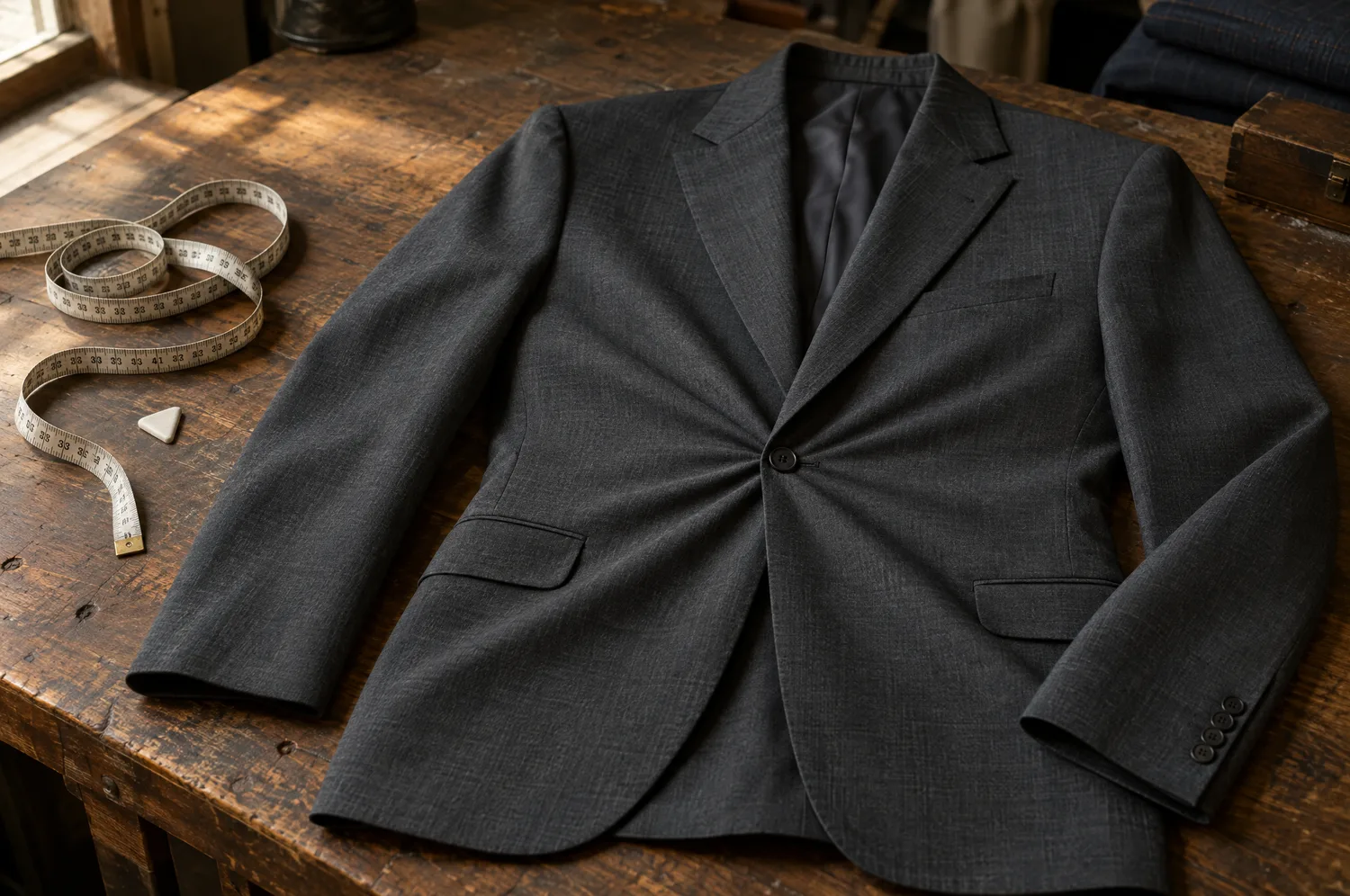
You can learn most of what a tailor will tell you about a suit that’s got tight in about ten minutes in front of a full-length mirror. Put on the whole suit with the shirt and shoes you’d wear, button the jacket, and run these six tests. Each one points at a specific seam, and each seam either has cloth to give or it doesn’t.
A phone camera helps. Set it on a timer and photograph yourself from the side and the back; few of us have ever seen the back of our own jacket.
1. The X at the button
What to do: Button the jacket (the top button of a two-button, the middle of a three) and stand naturally, arms at your sides.
What it means: Creases radiating from the button in an X, pulling towards your hips and your chest, mean the jacket is too tight at the waist. If the front edges also pull apart above or below the button, so you can see a triangle of shirt, it is tight through the waist and the stomach.
Can it be let out? Often, a little. A jacket’s waist is let out through its seams, usually the centre back and the side seams, and well-made jackets tend to leave some cloth in them. Altogether that is usually around an inch to an inch and a half on a well-made jacket, and less on a cheap one. If the X is faint, that may be enough. If the button only closes with effort, it won’t be.
2. The vents
What to do: Turn your back to the mirror (or use the timer) and stand relaxed, hands at your sides.
What it means: Vents should hang closed, the two flaps overlapping neatly. If they spread open into a V or a gap, the jacket is tight across your seat and hips. A single centre vent will pull open; side vents will lift and flare.
Can it be let out? Sometimes. Room at the hips comes from the same side and back seams as the waist, so there is a shared budget: an inch used at the waist is an inch not available at the hips. If both the X and the vents are bad, the jacket is probably past saving.
3. The trouser pockets
What to do: Stand facing the mirror with the trousers fastened and look at the side pockets.
What it means: Pockets should lie flat against your hips. If they pull open into little mouths (tailors call it pocket flare), the trousers are tight through the hips and seat. Horizontal creases across the front below the waistband, sometimes curving up like a smile at the fly, say the same thing.
Can it be let out? Usually, if there is cloth in the centre back seam. That one seam is where most of the trousers’ spare room lives, and you can check it yourself by turning the trousers inside out.
4. The sit-down
What to do: Sit on a hard chair as you would at a desk or a dinner, then stand up again.
What it means: Sitting adds an inch or more to your waist and hips, which is why trousers that pass standing up fail at the table. If the waistband digs in, the back of the waistband gapes away from your shirt, or you can feel the seat seam straining, the trousers need more room at the waist and seat than the mirror suggested.
Can it be fixed? Partly. Letting out the waist and seat helps. If the waistband still cuts in because it’s sitting below your stomach, more cloth isn’t the answer; the trousers are sitting in the wrong place, and the fix is a different rise and braces.
5. The reach
What to do: Button the jacket and reach both arms forward as if you were driving, then cross your arms.
What it means: Some pull across the back is normal in any tailored jacket. Tension that feels like it might tear across the shoulder blades, sleeves gripping your upper arms, or the collar lifting off the back of your neck mean the jacket is too small across the back and the arms.
Can it be fixed? Rarely. The back and the armholes are built into the structure of the jacket, and the sleeve seams leave very little to give. This is the test that sends most jackets to the pass-on pile, and it’s better to learn it in the mirror than in the car on the way to a wedding.
6. The collar
What to do: Button the shirt collar and slide two fingers, flat, between the collar and your neck.
What it means: Two fingers should fit snugly. If one barely fits, or the collar points lift and splay when you knot a tie, the collar is too small. When the neck is tight, the tie knot sits crooked and the collar points curl, and people notice it before anything else about you.
Can it be let out? Not usefully. A collar is a small, stiffened, shaped piece with very little cloth to spare, and Sam doesn’t alter shirts. For one event, a collar extender buys you about half an inch under a tie. For every day after that, the answer is shirts measured to your neck as it is now. More in the guide to tight collars.
Reading the results
Count where your faults landed.
- Waist and seat only (tests 1 to 4): good candidates for letting out, if the seams have cloth in them.
- Back, arms and chest (test 5, a severe test 1): usually past alteration; the structure is too small.
- Collar (test 6): new shirts, and an extender in the meantime.
Then bring the garments that passed to a tailor with the shirt and shoes you’ll wear. Sam checks every piece on you and quotes the work before anything is unpicked, and if letting something out won’t give you a result worth paying for, he’ll tell you. More on what’s worth saving in when to alter, when to replace.