How much can trousers be let out? The centre back seam, explained
Updated September 2026 · Sam’s Menswear editorial team
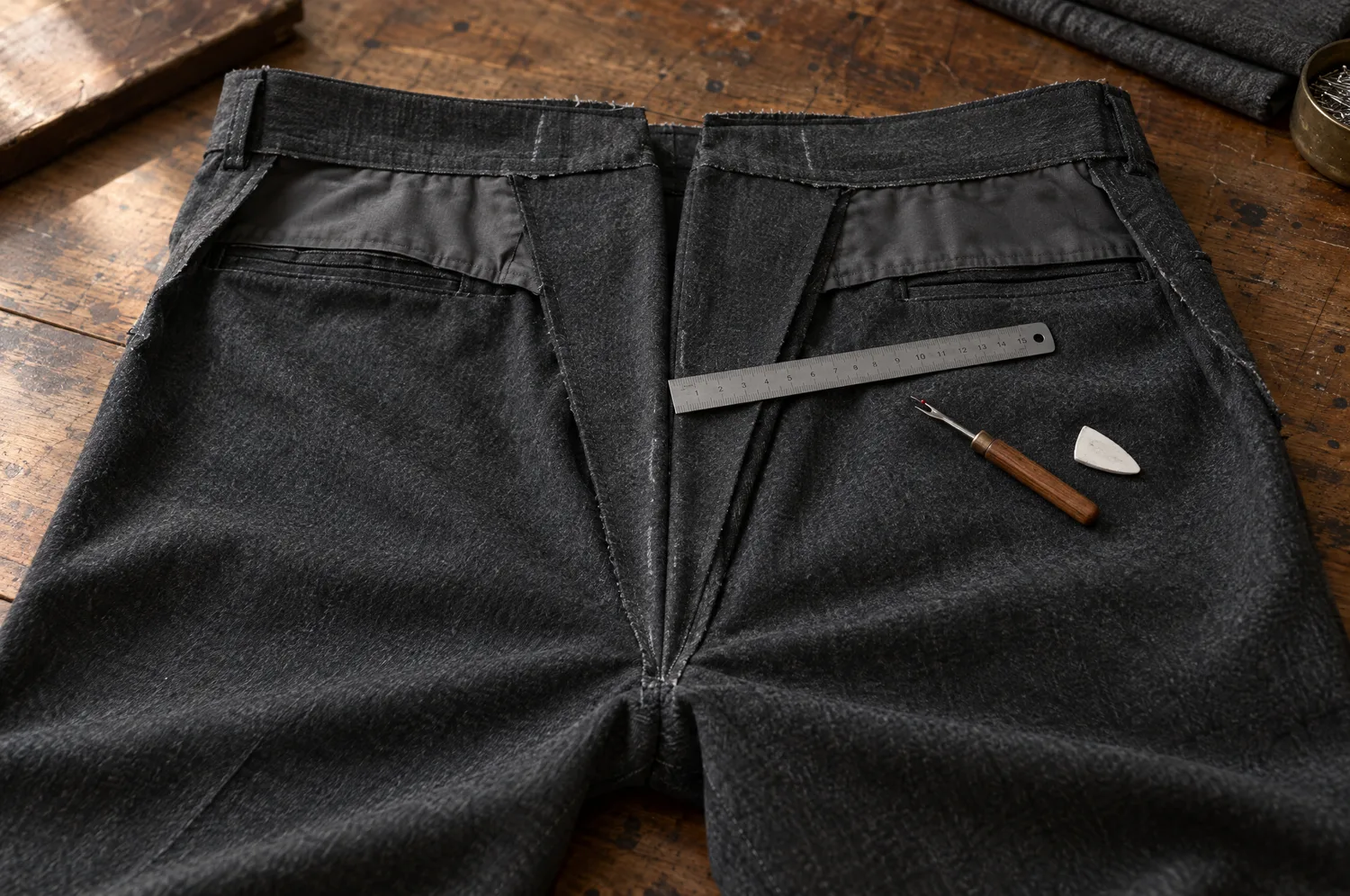
Whether a pair of trousers can be let out isn’t a matter of a tailor’s skill. It’s a matter of whether the cloth is there. And on almost every pair, the cloth that matters lives in one place: the seam that runs down the middle of the back, from the waistband to the crotch.
You can find out how much is in it at home, in two minutes, before you carry anything to anyone.
Where the spare room lives
When good trousers are cut, the back pieces are left with a generous seam allowance down the centre back. Tailors call it the outlet or the inlay. It’s folded inside the seam, out of sight, and it isn’t even: it’s a wedge, widest at the top where the waistband is and narrowing to almost nothing where the seam curves under towards the crotch.
That shape is the whole story of what letting out can do.
- The waist can grow the most, because the wedge is widest there.
- The seat can grow some, because the wedge is still there behind you.
- The crotch can’t grow at all, because the wedge has run out.
The other seams carry little. The side seams and the inside leg seams are cut with narrow allowances, often only enough to stitch through, which is why the thighs and the hips at the side are rarely let out in any meaningful way.
Check it yourself
- Turn the trousers inside out and lay them on a table, back facing up.
- Find the centre back seam and look at it from the waistband down. On good trousers you’ll see a wide band of folded cloth on each side of the stitching, pressed open or overlocked together.
- Lay a ruler across it at the top, just under the waistband. Measure the spare cloth on one side of the stitching line.
- Do the same about halfway down the seat.
As a rough guide, double the measurement at the top to get the most the waist could grow, but keep a little back: a tailor needs some cloth left to make a new seam. On well-made trousers that often comes to an inch or two at the waist. On inexpensive trousers you may find a quarter of an inch, overlocked tight, which means there is nothing to give.
The waistband decides how easy it is
Now look at the waistband where it crosses the centre back seam.
A split waistband is made in two halves joined at the back, often with a small V cut into the top. The waistband has its own spare cloth at that join, so seam and waistband can be let out together. Well-made trousers are built this way precisely so they can be altered.
A one-piece waistband runs unbroken across the back. To let the waist out, a tailor has to deal with a band that has nothing spare in it, and the result is either limited or a visible join. Many ready-made trousers are built this way because it’s quicker to make.
Belt loops matter a little too. The loop over the centre back seam has to come off and go back on, which is routine. Trousers with side adjusters instead of a belt add a useful twist: the adjusters themselves give an inch of daily give, which can be the difference between needing an alteration and not.
What letting out can’t do
It can’t lengthen the front. The front of the trousers, from the waistband down past the zip to the crotch, is the front rise, and there’s no cloth to let out there. When weight comes on at the stomach, the front often needs more length, not just more width, which is why some trousers that have been let out still sit under the belly. That’s a job for a different cut; see trousers for a bigger belly.
It can’t widen the thighs. If the trousers grip your thighs when you sit, the inside leg seams have very little to give. Thighs that rub also wear trousers out faster; why trousers wear out first explains what to do about it.
It can’t happen twice. Once the outlet has been used, it’s gone. If a pair has been let out before, the seam will show it: the spare cloth will be narrow and there may be old stitching lines inside.
The ghost line
Letting out moves the stitching onto cloth that used to be hidden inside the seam, and that cloth can look slightly different.
- Needle holes and the old fold. The old stitching line and the crease where the cloth was folded can stay faintly visible after pressing, a thin line running down the seat. Steam and a good press reduce it; on some cloths it never quite goes.
- Colour. Cloth inside a seam hasn’t seen the sun, the dry cleaner or years of wear. On trousers that have faded, the let-out strip can be a shade darker than the rest.
How much it shows depends on the cloth. Dark, smooth, tightly woven worsteds and gabardines show it most. Flannels, tweeds, textured weaves and mid-greys hide it well. A good tailor will look at the cloth and tell you before starting, and will press the seam open on the inside so you can see what you’d be getting.
When it’s worth doing
Letting out is worth it when the outlet is there, the waistband is split, the cloth is in good condition and the trousers are worth keeping: a suit’s trousers, a pair you love, a cloth you can’t easily replace.
It’s less worth it when the trousers are inexpensive, the outlet is thin, they’ve already been let out once, or the real problem is the rise rather than the waist.
Sam lets out trousers at the waist and seat as part of his alterations, and he’ll check the seam with you before anything is unpicked. If there isn’t enough cloth to do it properly, he’ll tell you so. When new trousers are the answer, they’re cut to your measurements as you are now, with a waistband and rise that suit the way you’re built.