Big & tall, short, or in-between: fit for real bodies
Updated July 2026 · Sam’s Menswear editorial team
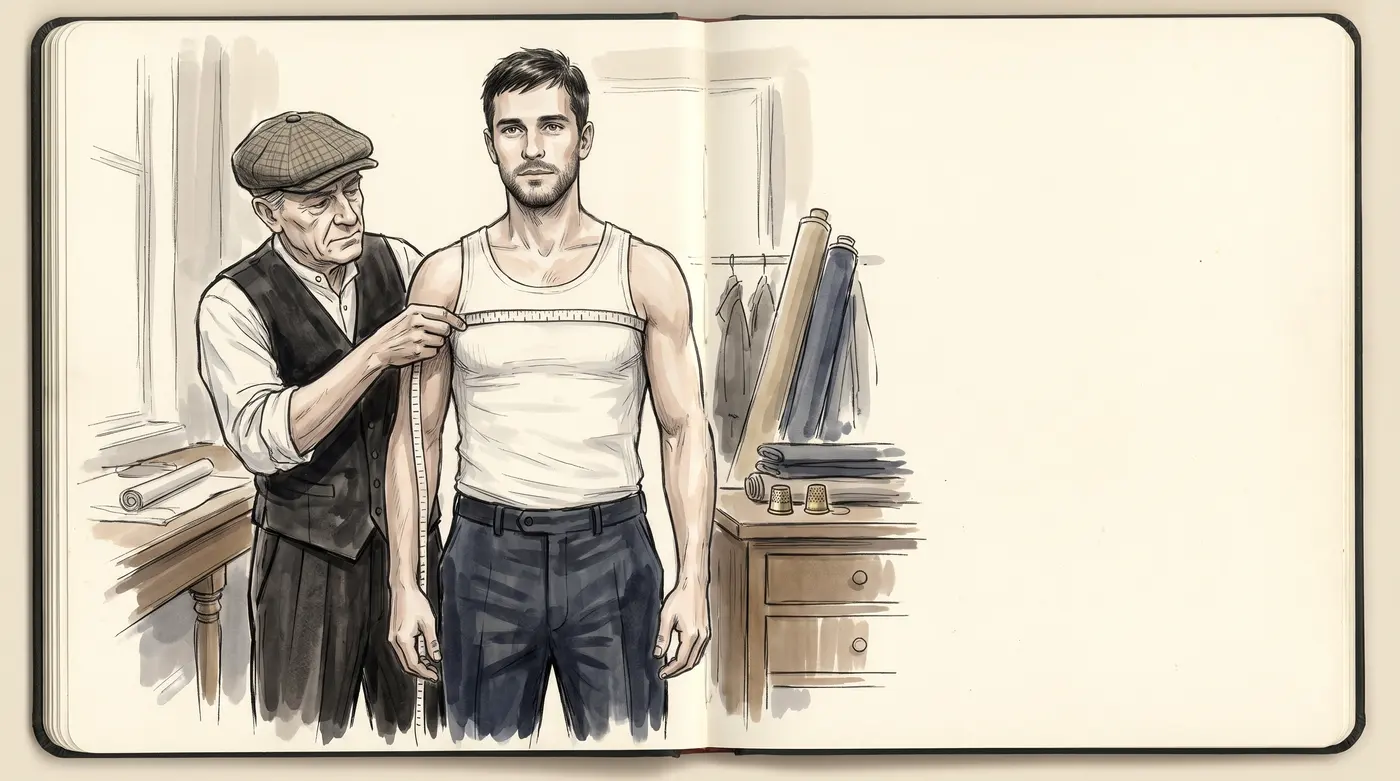
Off-the-rack suits are built for one imaginary “average” body: a 6-inch drop between chest and waist, average height, average arm length. If you’re big, tall, short, or shaped like a real person, the suit is fighting your proportions before you even try it on. The fix isn’t more alterations. It’s a pattern cut for your body from the start.
Why do off-the-rack suits fit me so badly?
Because they’re sized on ratios, not on you. A size 40 jacket automatically comes with size 34 trousers; that’s the standard “6-inch drop.” If your chest and waist don’t sit in that exact ratio, you’re already compromising.
Anthropometric research puts it bluntly: only about a quarter of men fit standard off-the-rack sizing without needing serious alterations. Everyone else is buying a suit built for a shape that isn’t theirs. The store just doesn’t tell you that part.
A suit fits at a handful of fixed points: shoulder, chest, jacket length, trouser rise. Off-the-rack locks those in at the factory. When your body doesn’t match, no fitting room and no tailor can fully undo it.
What can’t a tailor fix after I buy?
The big ones: shoulders, jacket length, and trouser rise. If those are wrong off the rack, you’re stuck. Those are the exact points that decide whether a suit looks made for you.
- Shoulders: the single most important fit point. If the seam doesn’t sit at the edge of your actual shoulder, nothing below it saves the jacket. Rebuilding a shoulder is the most expensive alteration there is, and it’s rarely worth it.
- Jacket length: this sets where the pockets and buttons land. You can’t move a pocket up two inches. Shorten the jacket and the proportions collapse.
- Trouser rise: the front-waist-to-crotch measurement. Changing it means rebuilding the waistband and zipper. Most tailors won’t touch it.
A tailor can take in a waist, shorten a sleeve, hem a trouser. That’s it. The bones of the suit are set the day it’s cut. More on the honest limits in how a suit should fit.
What goes wrong for big and tall guys?
Your dimensions don’t move together, and off-the-rack forces them to. Size up for your waist and the shoulders drown you; size for your shoulders and the midsection strangles you. There’s no middle setting.
If you carry weight through the middle, buying to your waist gives you shoulders two sizes too wide and sleeves past your knuckles. Buying to your shoulders means you can’t button the jacket. The factory pattern assumes chest and waist rise together in lockstep. Real bodies don’t. If you’ve gained weight and your current wardrobe has stopped fitting, start with a plan for the clothes you already own.
Tall and lean has the opposite trap. “Tall” sizing adds length, but it also adds width, because the pattern just scales everything up. So the sleeves finally reach your wrists, but the shoulders hang off you like a coat hanger, and the chest balloons. You end up looking bigger and sloppier than you are.
A cut-for-you pattern treats every measurement on its own (chest, waist, shoulder, sleeve, seat, thigh, jacket length) so they can each be right at the same time. That’s the whole point of designing your own suit.
What about shorter men?
Shorter builds get swallowed. The jacket runs long, the buttons sit low, the trouser rise stacks fabric at the waist, and every proportion reads a beat off, even when the size is “correct.”
The problem is rarely that you’re small. It’s that off-the-rack length and rise are cut for someone four inches taller, so the jacket covers too much of you and the pants pool. Shortening the hem helps a little; it can’t fix where the button stance and pockets sit. Those are baked into the length.
A shorter man in a properly proportioned suit looks taller, not smaller, because the button stance, lapel width, and jacket length are all scaled to him. That’s proportion doing its quiet work.
When is it actually time to go custom?
A simple rule from the trade: if you always leave the store needing major alterations, or your chest-to-waist drop is bigger than 7 inches or smaller than 4, off-the-rack will never really work for you.
Also go custom if your shoulders are noticeably broader or narrower than your chest size suggests. That mismatch is the one alterations can’t chase down. If you’ve spent years telling yourself “it’s close enough,” it probably never was.
This isn’t about luxury. It’s about a garment that starts from your measurements instead of a national average. If you want the full breakdown of the options, read bespoke vs. made-to-measure vs. off-the-rack.
How does a custom suit fix proportion for good?
It starts with your body, not a size label. Sam takes every measurement independently, drafts a pattern to it, and cuts the fabric to match, so shoulder, length, and rise are right from day one, not fought over later.
That’s the difference. Off-the-rack asks your body to compromise. A custom pattern makes the suit do the compromising (none, ideally). Big, tall, short, broad, narrow, or some combination the size charts never imagined: it’s just a set of numbers, and numbers are what a tailor works from.
Thirty-plus years at the bench in Vaughan, on the Thornhill line, means Sam has cut for every build that’s walked in. The choice of fabric matters too, since heavier and structured fabrics drape differently on different frames. If you’re carrying weight, a good drape does half the work.
We do this for weddings, for work, and for traditional wardrobes: same principle every time. See more on tricky builds in suits for hard-to-fit bodies.
If off-the-rack has never once fit you right, that’s not your fault. It’s the pattern. Come in for a first fitting and let’s put real numbers on your shoulder, length, and rise, the three points no store can change. Or start now and design your own suit. We’ll build it to your body, not the average.