Fat guy in a little coat: what Tommy Boy teaches about wearing someone else's jacket
Updated October 2026 · Sam’s Menswear editorial team
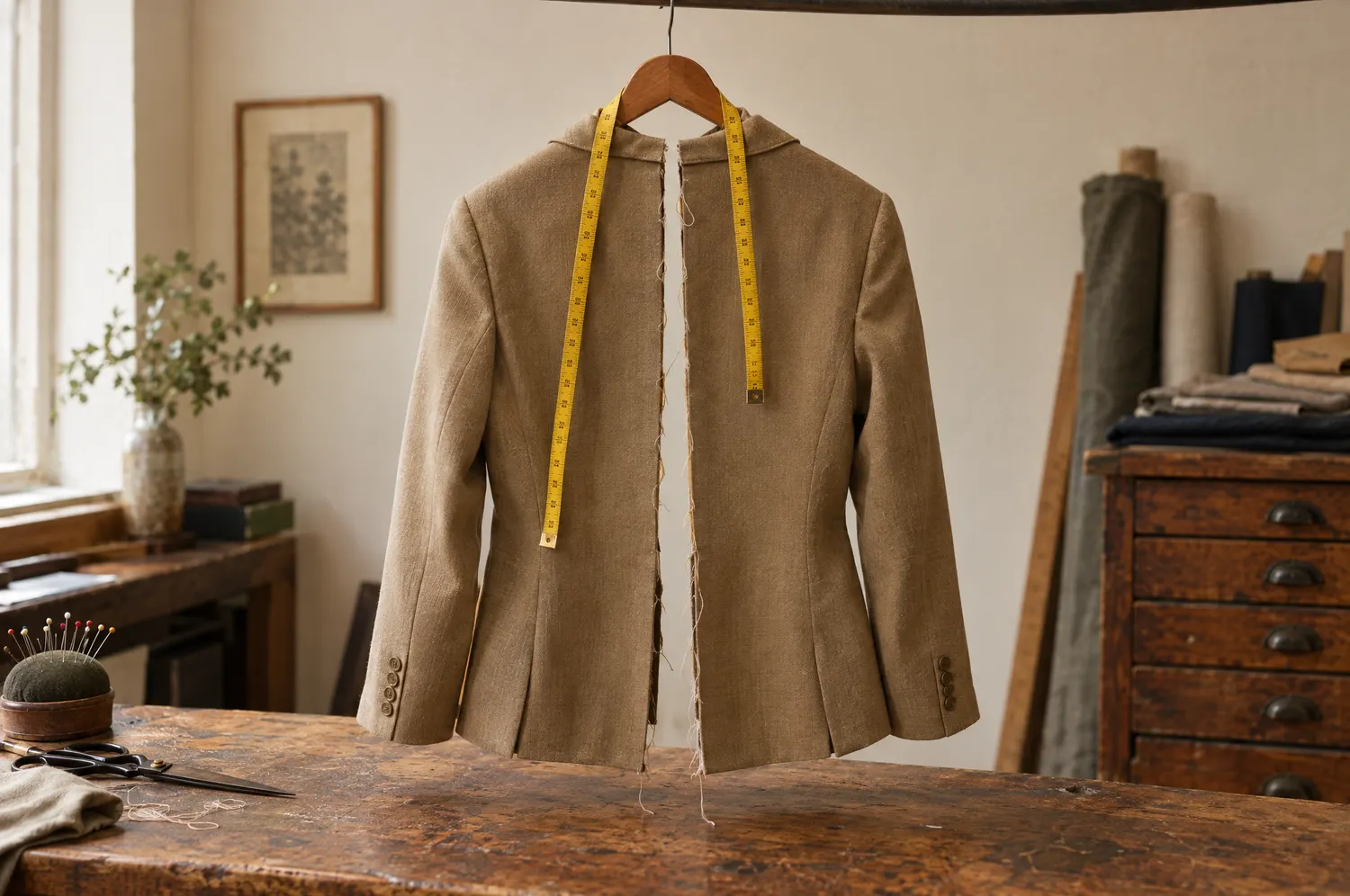
If tailoring has a favourite film scene, it might be this one. In Tommy Boy (1995), Chris Farley’s Tommy pulls on the jacket belonging to David Spade’s Richard, sings a little song about being a fat guy in a little coat, dances about, and the jacket tears in two down the back.
The bit started years earlier. Spade has said that when the two were meant to be writing together at Saturday Night Live, Farley would get bored and put on Spade’s jacket to annoy him. In an online Q&A, reported by Bustle, he said the singing was not the plan, and that they cut the back of the coat beforehand to make sure it would rip.
That last detail is the tailor’s favourite part. Real jackets rarely give up that neatly. They do something worse: they hold together and pull, all day, in every photograph.
Why does a too-small jacket fail at the back?
A jacket has one long seam straight down the middle of the back, and it sits over the widest, hardest-working part of your upper body.
When you move your arms forward, to reach, hug or shake a hand, your shoulder blades spread apart and your back gets wider. A jacket cut with room across the back lets that happen. A jacket cut for a narrower man has nowhere to give, so the strain goes to the centre seam and the armholes. On screen, with a little help, the seam lets go. In life, the jacket drags at the collar, the sleeves climb up your forearms, and the button strains.
Can you borrow a jacket for a wedding?
This is where the film comes true for most men. A groomsman borrows his brother’s jacket, or his father’s, or wears the one he bought at twenty-two. It fastens, just, in the mirror at home. Then come the first dance, the group hug and the photograph with his arms around two cousins.
Sometimes a borrowed jacket works, usually when the two men really are the same build. The test is quick, and it is worth doing a few weeks out rather than the night before.
- Look at the shoulder seam. It should end where your shoulder bone ends. If it stops short and the sleeve pulls a ridge into your upper arm, the jacket is too narrow, and that cannot be changed.
- Hug someone. Or reach forward with both arms as if you were. If you feel the jacket across your shoulder blades and the collar lifts off your neck, the back is too narrow.
- Fasten it and look for an X. Creases pulling out from the button towards your hips and chest mean the waist is tight. That part is sometimes fixable.
- Check the sleeve length with your arms at your sides. About a quarter inch of shirt cuff should show.
Six mirror tests goes through each fault in more detail.
What can a tailor change on a borrowed jacket, and what can’t he?
| Usually possible | Not possible, or not worth it |
|---|---|
| Let out the waist through the side and centre back seams, often an inch to an inch and a half in total on a well-made jacket | Widen the shoulders |
| Take in the waist and sides | Add room across the back or chest |
| Shorten sleeves, if the cuff buttons are decorative | Make armholes bigger |
| Lengthen sleeves, if there is cloth folded inside the cuff | Lengthen the jacket body |
| Hem, take in or let out trousers, if the back seam has cloth in it | Fix trousers that sit too low under a belly |
Two catches are worth knowing. If the sleeves have working buttonholes at the cuff, they can’t be shortened from the cuff without moving the holes, which usually means taking the sleeve off at the shoulder. And everything above the waist that fails the hug test is beyond alteration, because the cloth to add simply isn’t in the seams. How a suit should fit explains why the shoulders decide everything.
What does altering it cost the jacket’s owner?
More than people expect. Alterations are permanent. Letting a seam out moves the stitching onto cloth that was folded inside, and on dark, smooth cloth the old line can stay faintly visible. Take the sleeves in for your arms and the owner gets back a jacket that no longer fits him. Ask before anything is unpicked, and expect to pay to have it put back.
Should you just buy a size up instead?
That is the other half of the Farley problem. Men with a belly, broad shoulders or a big chest often buy the next size up so the button closes, and then live with shoulders that overhang and sleeves that reach the knuckles. A bigger jacket fixes one measurement by ruining the rest. The answer is a jacket cut with each measurement separate: the shoulders for your shoulders, the waist for your waist. Big, tall and in-between is written for exactly this.
What should you do before the wedding?
If the borrowed jacket passes the shoulder and hug tests, bring it in. Sam alters suits and jackets whether he made them or not, handed-down ones included, and will tell you before anything is unpicked whether it is worth doing; see alterations. If it fails, a suit made to your measurements takes three to four weeks with one fitting, and for a wedding two to three months ahead is comfortable. A few days before the wedding, only alterations or pressing are possible, never a new suit. Book a time and wear the jacket you suspect is too small.
Where the story comes from: TV Guide on Spade’s account of the bit and Bustle on how the rip was shot.