Academics: lecture-to-boardroom wardrobe
Updated July 2026 · Sam’s Menswear editorial team

Academics live in a wardrobe with a wide range: a lecture hall on Monday, a committee room on Tuesday, a conference podium in another city on Thursday. The trick isn’t owning a lot of clothes. It’s building a small set of pieces around one great blazer, so you always look like the sharpest person who clearly wasn’t trying too hard.
What should a professor actually wear day to day?
A blazer or sport coat over a collared shirt and good trousers. That’s the whole uniform. It reads as “serious scholar,” survives being taken off in an overheated seminar room, and takes you from lecture to a meeting with the dean without a costume change.
Most campuses run business casual, and the smart move is to dress a small notch above whatever the room expects. You never lose credibility by being the best-dressed person at the table. Day to day, that means:
- A soft-shouldered sport coat (navy or grey)
- A collared shirt, no tie required
- Well-fitted wool or cotton trousers, or good chinos
- Clean leather shoes and dark socks
The look should quietly disappear. Students remember the lecture, colleagues remember the argument, and nobody remembers what you had on. That’s the goal.
Why is the versatile blazer the anchor of an academic wardrobe?
Because one well-cut blazer does the work of a whole closet. It dresses up jeans on a teaching day, layers over a shirt-and-tie for a talk, and softens the room in a committee meeting. It’s the single most useful thing an academic can own.
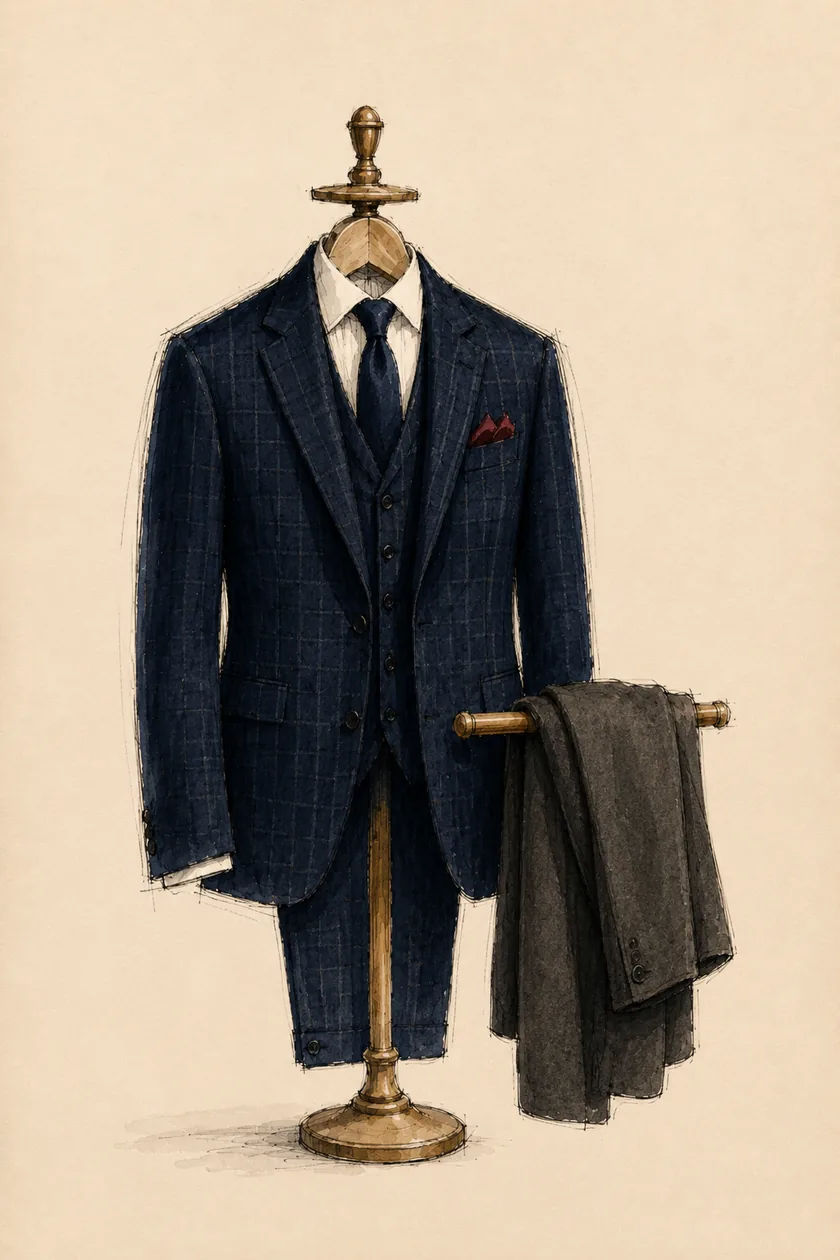
The magic is in the fabric. A worsted wool from a business suit is fine for a boardroom but stiff for a campus. For a professor, I steer people toward fabric with texture and give: a wool hopsack, a flannel, a tweed for winter, a cotton-linen blend for the warm months. Texture is what separates a proper sport coat from a suit jacket that lost its trousers.
Colours that never let you down: navy hopsack (spring to fall), grey or brown tweed (winter), and a tan or olive in summer. Buy one, wear it into the ground, then buy the second. Browse the fabric library to see the weights that hold up to real weekly wear.
How many jackets does a working academic really need?
Two to start, three to be comfortable. A navy all-rounder, a textured winter jacket, and a lighter summer one covers a full teaching year in the GTA without repeating yourself in a way anyone would notice.
Here’s the math. If you rotate two jackets across a five-day week, each one gets a rest, wears evenly, and lasts years longer. Add a third and you’ve quietly got a full seasonal wardrobe. That’s a smaller investment than most people fear, and it’s the backbone of dressing for your profession.
Pair those jackets with three or four pairs of trousers and a handful of good shirts, and you can go a full term without anyone clocking a repeat. That’s the efficiency tailoring buys you.
What should I wear to an academic conference?
A blazer you can put on for your session and take off for the hallway. Conferences run business casual, but presenters should dress one step above the crowd, so the jacket does double duty: authority on the podium, comfort the rest of the day.
A few things I tell clients heading to a conference:
- Bring a jacket that travels. High-twist wool resists wrinkles in a suitcase and breathes in a hot session room.
- Layer for the air conditioning. Conference halls swing from freezing to stuffy. A jacket is your thermostat.
- Comfortable, real shoes. You’re on your feet for ten hours. A polished leather shoe or clean loafer beats sneakers and won’t kill your back.
- Skip the loud prints. Soft blue, white, subtle pattern. Let your work be the interesting thing in the room.
What do I wear for a job talk versus a committee day?
For the job talk itself, wear a proper suit. It’s the most important presentation of your career and you want zero doubt about whether you took it seriously. For the campus visit and faculty meetings around it, a sport coat is right.
The distinction matters. A suit on the podium says the day is a big deal. A blazer for the follow-up meetings says you belong there and are comfortable. Overshooting the committee-day dress code can read as stiff; a good sport coat with a tie held in reserve gives you room to match the mood of each meeting.
If you’re on the hiring side of the table, the same logic runs in reverse: dress at the level you want the candidate to rise to. A well-tailored jacket sets the tone for the whole room.
Can one wardrobe cover lecture, committee, and conference?
Yes, and that’s the entire point. Build around versatile jackets, neutral trousers, and shirts that work with or without a tie, and the same eight or nine pieces recombine into every situation your calendar throws at you.
That’s what fit does that shopping can’t. Off-the-rack, the shoulders fight you and the sleeves sit wrong, so the jacket only works in one context. Made to your frame, it moves with you from the lectern to the seminar table to the podium. If you carry weight in the shoulders or have a hard-to-fit build, that’s exactly where a tailor earns his keep, see suits for hard-to-fit bodies.
And a jacket that lives on your back all week has to be built to last. A little care goes a long way, how to care for your suit covers the basics, and if you’re weighing whether to invest at all, the navy suit makes the case for the one piece every professional should own.
Where do I start?
Start with one great blazer and let it prove itself. Bring your teaching calendar to the first appointment and we’ll pick a fabric that can handle a five-day week of lecterns, seminar rooms, and overheated conference halls. When you’re ready, book an appointment or start to design your jacket. We’re on the Thornhill line in Vaughan, serving Toronto, North York, Richmond Hill, and Markham.