How to read a suit’s quality in 30 seconds
Updated July 2026 · Sam’s Menswear editorial team
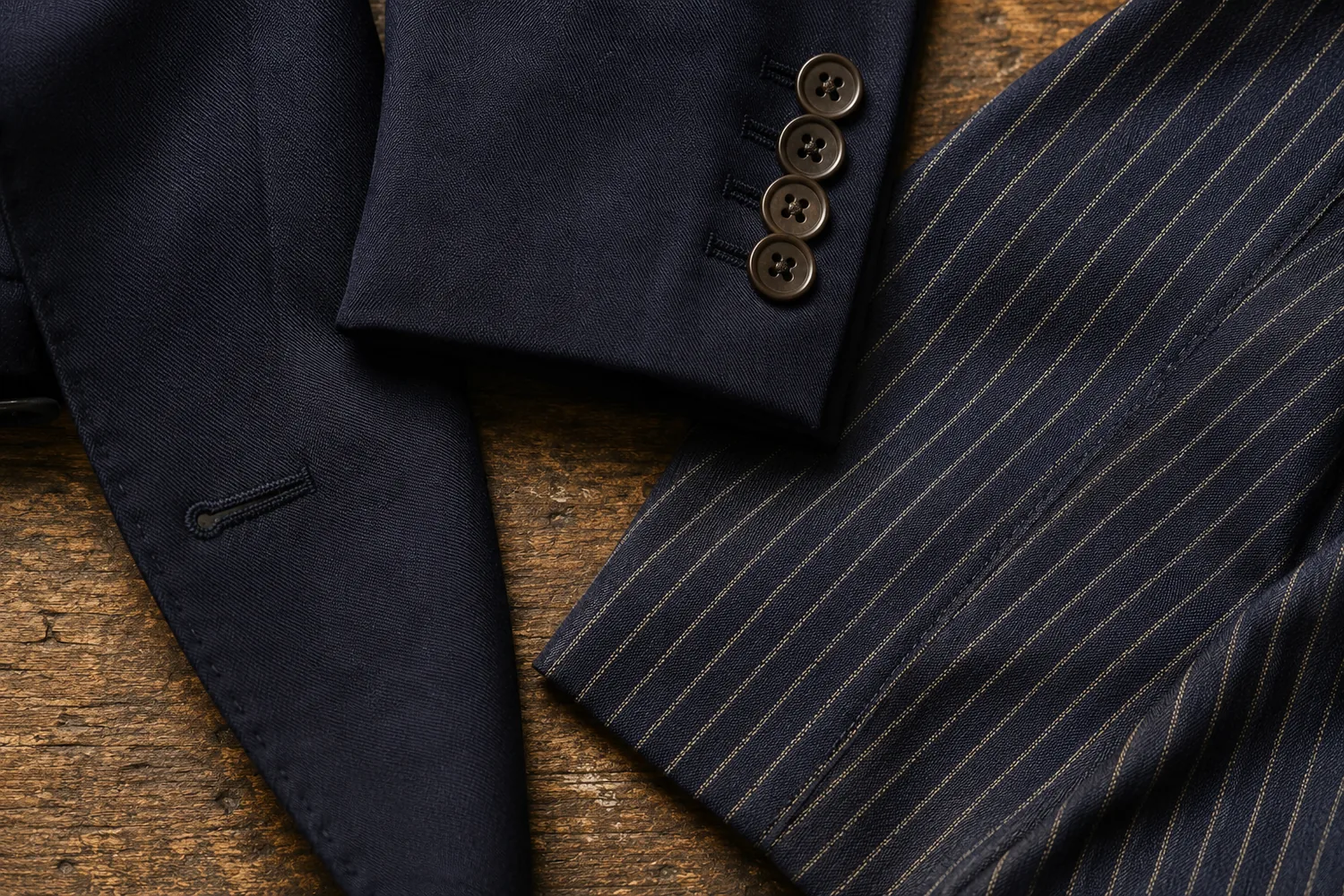
A good suit tells you the truth in a few seconds if you know where to touch. Pinch the fabric below the bottom buttonhole for a floating third layer (canvas), check the buttonholes and seams up close, and feel the fabric’s weight and recovery. Those four tells separate a suit built to last from one that’s glued together.
What makes the best custom-tailored suit?
The best custom-tailored suits share five things:
- A pattern drafted to your body, not a factory size adjusted after the fact.
- Full or half floating canvas, never fused glue that bubbles and dies.
- Fabric matched to how you live: weight, weave and season, not just a Super number.
- Hand-finished details: buttonholes, working cuffs, a lining you actually chose.
- A tailor who keeps your pattern and re-fits it as your body changes.
A custom-tailored suit with all five outlasts and out-fits anything off a rack. The quick tests below are how you spot each one in ten seconds.
What’s the fastest way to tell if a suit is good quality?
Pinch the front of the jacket just below the lowest buttonhole. If you feel three distinct layers that slide independently, it’s canvassed, the sign of real construction. Two stiff, glued-together layers means it’s fused.
That single move is the most honest test in menswear. In a canvassed jacket you’ll feel the outer fabric, a floating middle layer (the canvas), and the lining. In a fused jacket the chest piece is glued straight to the fabric, so it feels like stiff cardboard and moves as one board. Do it in ten seconds and you already know most of what you need. Everything else on this page just confirms the story your fingers already told you.
What is canvassing and why does it matter?
Canvas is the internal layer (often horsehair and wool) that gives a jacket its shape. It matters because canvas moves with your body and molds to your chest over time; glue can’t do that.
There are three levels, and you can feel the difference:
- Fully canvassed: canvas runs the whole front. Pinch anywhere down the front and you feel the floating layer. Best drape, best longevity.
- Half-canvassed: canvas in the chest and lapels, fused below. Pinch up top and it floats; pinch near the hem and it doesn’t.
- Fused: glued throughout. Cheapest, and after enough dry cleans the glue can bubble and the chest goes wavy, the “cheap suit ripple” you can’t press out.
A fused jacket can look fine on the rack. It just won’t age with you, and it can’t be let out or reshaped the way a canvassed one can. That’s the difference between a suit you replace and one we adjust for fifteen years. More on that trade-off in custom vs. rental and the custom tuxedo.
How can you spot quality in the seams and stitching?
Turn the jacket inside out and look at the seams. Quality seams are clean, flat, and generous, with enough spare fabric (inlay) tucked inside to let the suit out later. Puckered, tight, raw-edged seams are a bad sign.
A few fast tells:
- Pattern matching. On a stripe or check, the lines should meet across the seams, at the pockets, and along the shoulder. Mismatched patterns mean corners were cut on fabric and labor.
- Inlay. Fold back a side seam. A well-made suit leaves an inch or two of extra fabric so a tailor can size it up. Fast fashion trims it to nothing.
- The collar. It should hug the neck with no gap when you stand straight. A gapping collar is poor construction or a bad fit, often both.
This is where a real tailor earns their keep. A machine spits out a seam; a bench-made suit is built to be opened up and rebuilt. See suits for hard-to-fit bodies for why that inlay matters.
Do hand-sewn buttonholes really signal quality?
Yes, not because the stitch itself is magic, but because it travels with better construction. A hand-sewn buttonhole almost always sits on a canvassed, carefully finished suit. A machine one tells you nothing either way.
Here’s how to read them fast. A hand-sewn buttonhole has slight, human irregularity: a little three-dimensional ridge, a subtle teardrop shape at the opening. A machine buttonhole is perfectly uniform on both sides with a clean keyhole. Neither is “wrong,” but the hand-finished one is a flag that someone spent real time on the whole garment.
Two things worth checking:
- Working sleeve buttons (surgeon’s cuffs). If the cuff buttons actually unbutton, that’s a hand-finishing detail. Just note it makes sleeve-length alterations harder.
- The Milan buttonhole on the lapel (a raised, silk-gimped hand buttonhole) is the top of the craft. You’ll rarely see it outside serious tailoring.
How do you judge the fabric in a few seconds?
Scrunch a handful of the fabric in your fist, hold it three seconds, and let go. Good wool springs back with few creases. Cheap or high-synthetic fabric stays wrinkled and often feels papery or plasticky.
What your hand is reading:
- Recovery: quality wool bounces back; it resists creasing all day.
- Weight and body: a suit around 9–11 oz fabric drapes and holds a press. Feather-light “tropical” blends can look flat and lifeless.
- Hand: real wool feels dry and alive. A slick, cold, shiny surface usually means a lot of polyester.
Numbers like Super 120s or 150s describe how fine the yarn is, not how good the suit is; very high numbers are delicate and wrinkle easily, so don’t let a label do your thinking. Trust the scrunch. You can feel the difference across our fabric library, and the navy suit and how to care for your suit guides go deeper on choosing and keeping good fabric.
Does a quality suit have to be expensive?
No. Price tags include brand, markup, and store rent, none of which touch your body. A well-made canvassed suit from a tailor often costs less than a fused designer suit, because you’re paying for construction, not a logo.
What you’re really buying with quality is longevity and fit. A canvassed suit with proper inlay can be adjusted as your body changes and re-pressed for years without bubbling. A cheap fused suit is close to disposable: great for a season, gone after a few dry cleans. Over a decade, the “expensive” suit is usually the cheaper one.
Come by and put your hands on the difference yourself: pinch the canvas, scrunch the fabric, look at a real hand buttonhole. Thirty years at the bench, happy to show you what to look for. Book an appointment or design your own suit when you’re ready.