Why your off-the-rack suit will never fit (and what does)
Updated July 2026 · Sam’s Menswear editorial team
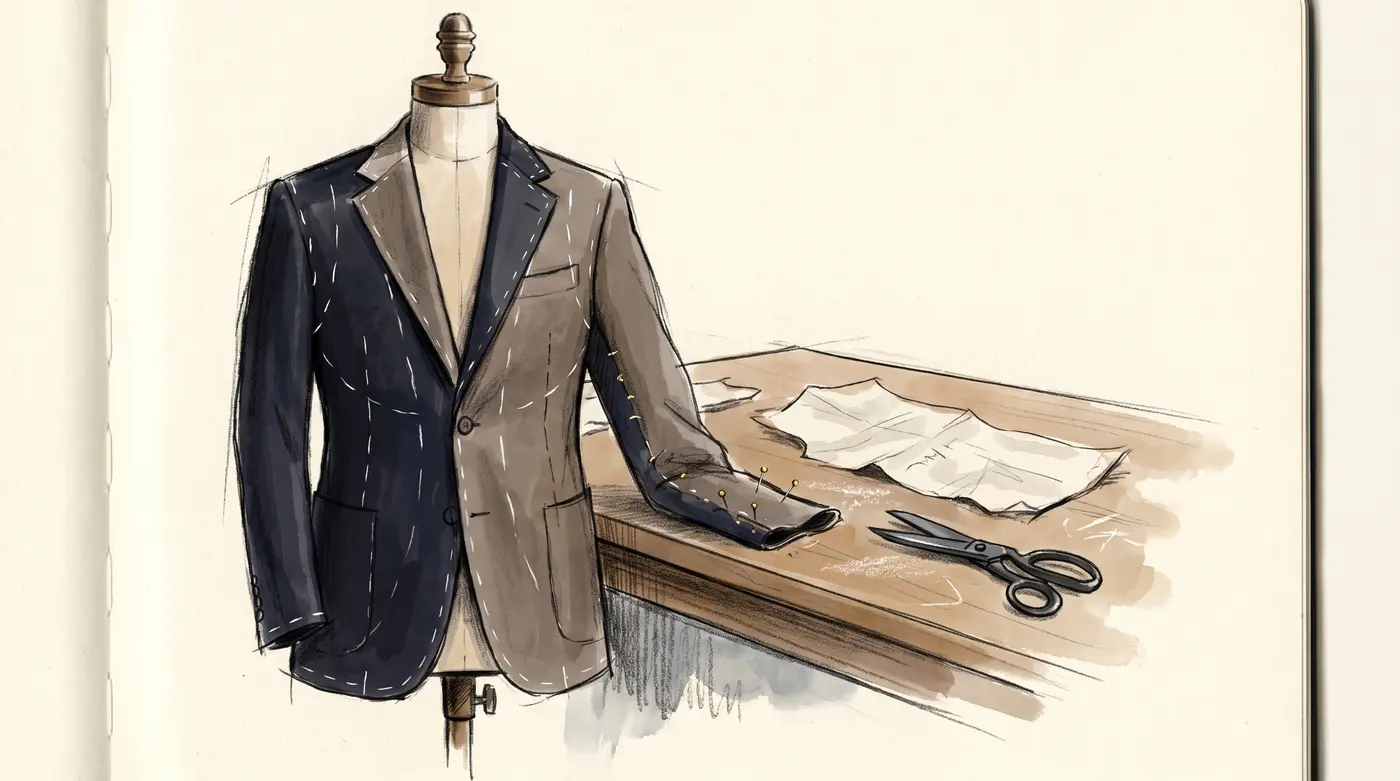
Short answer: an off-the-rack suit is built for an average body that doesn’t exist. It’s cut to fit a size chart, not you, so it can look decent, but it hits a fit ceiling that no amount of tailoring pushes past. The only way through that ceiling is a suit cut to your actual measurements: made-to-measure or bespoke.
I’ve been at the bench 30-plus years here on the Thornhill line. Guys walk in every week frustrated that a jacket “almost” works. It’s not you. It’s the pattern. Let me show you where the wall is and how to get past it.
Why doesn’t my off-the-rack suit fit no matter what I try?
Because it was cut to a standard size (say a 40R with a fixed “drop 6” waist), and standard sizes assume proportions almost nobody has. Your body has its own math.
An off-the-rack suit is made to a single set of assumptions: if your chest is 40, your waist “should” be 34, your arms “should” be a set length, your shoulders “should” slope a certain way. Real bodies don’t read the chart. One shoulder sits lower. Your seat is fuller, or your chest is deeper, or your arms are an inch longer than the pattern says. The suit fits the mannequin it was drafted on, not you.
What can a tailor actually fix on an off-the-rack suit?
The soft, edge stuff: waist suppression, sleeve length, trouser hem and waist, a little side taper. That’s real, useful work, but it’s finishing, not rebuilding.
Here’s the honest list of what a good tailor can do:
- Take in or let out the waist (within the seam allowance that exists)
- Shorten or lengthen sleeves
- Taper the trouser leg, hem it, adjust the waistband
- Light side seam taper to clean up excess through the body
I do all of this every day. On a suit that’s already close, it’s the difference between “off” and “sharp.” But notice what’s not on the list.
What can’t be altered on a suit? The fit ceiling
The shoulders, the chest, the armholes, and the overall balance. These are the bones of the jacket. Once they’re wrong, they stay wrong.
- Shoulders: the hardest, priciest area to touch. Maybe an inch of change, and only sometimes. Rule of thumb: if the shoulders don’t fit, don’t buy the jacket.
- Chest: most suits are sewn with almost no seam allowance, so there’s nothing to let out. Force it a centimetre and the whole front distorts.
- Armholes: off-the-rack armholes sit low so the size fits more people. Low armholes mean restricted movement and bunched fabric under the arm. Raising them is near-total reconstruction. Not worth it.
- Jacket length and balance: change the length and you move the pockets, the button stance, the whole proportion. A suit built around a different body stays a suit built around a different body.
That’s the ceiling. You can polish everything below it. You can’t move the ceiling. (More on where the line sits in what a tailor can and can’t fix.)
How much better does a suit that’s actually measured fit?
A lot. Industry rule of thumb: a premium off-the-rack suit with alterations tops out around 60–70% of ideal fit. Made-to-measure lands around 80–90%. Bespoke is the full 100%.
The reason is simple. Made-to-measure starts from a proven pattern and adjusts it to your real numbers (chest, waist, sleeve, shoulder slope, the works) before a single piece is cut. Bespoke goes further: the pattern is drafted from scratch for your body, with fittings along the way to dial in posture and asymmetry. Either way, you’re no longer fighting the pattern. The pattern starts as you.
Is off-the-rack ever the right call?
Yes: when you need something tomorrow, the budget’s tight, or you happen to have close-to-standard proportions and just need light alterations. No shame in it. I’ll tell you straight if an off-the-rack piece is worth altering.
But if you’ve bought “almost right” suits again and again, the math has already answered you. You’re paying for alterations that can’t reach the real problem. For the full breakdown of the three tiers, see bespoke vs made-to-measure vs off-the-rack, and whether the jump pays off in is a custom suit worth it.
Who hits the fit ceiling hardest?
Anyone off the standard grid: athletic builds with a big drop between chest and waist, taller and shorter men, fuller or leaner frames, broad or narrow shoulders, longer arms. The further you are from the mannequin, the worse off-the-rack fails you.
If that’s you, off-the-rack was never going to work, and altering it just moves fabric around a frame it was never cut for. That’s exactly the case we solve in suits for hard-to-fit bodies. Cut it to your measurements once and the “almost” disappears.
Where do I start?
Start with the fabric and the conversation, not a size tag. Whether it’s a suit for work, a wedding, or a traditional wardrobe, we begin with your body and how you actually move.
Come by for a first fitting and bring the suit that “almost” works. We’ll take your measurements, put a pin exactly where that jacket has been failing you, and look at fabric options. If it’s the right fit for you, we’ll design your suit from there. If off-the-rack is genuinely fine for what you need, I’ll tell you that too. Book whenever you’re ready. I’m right here on the Thornhill line, serving the GTA.