Storing & travelling with a suit
Updated July 2026 · Sam’s Menswear editorial team
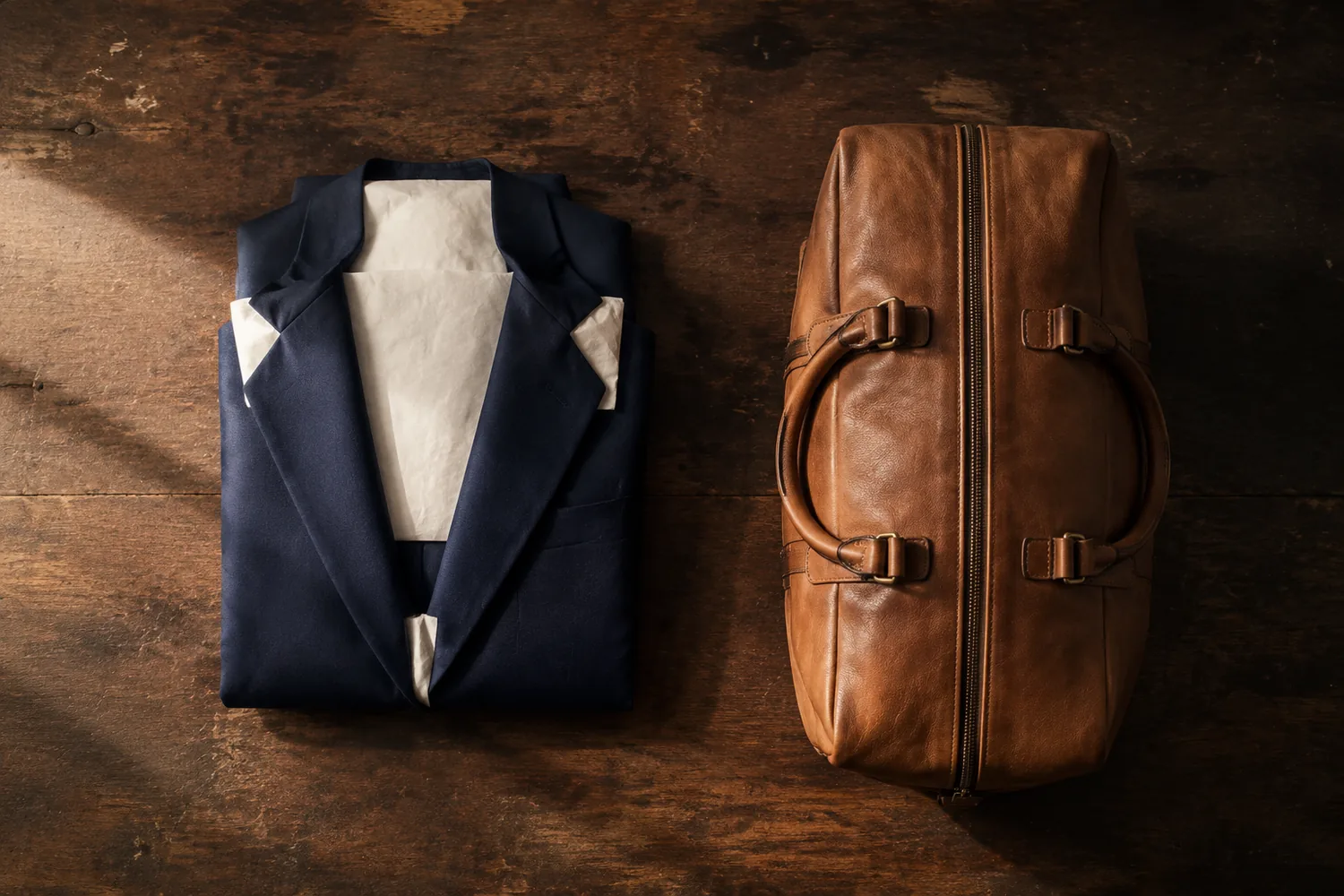
Store a suit on a wide wooden hanger with room to breathe, and let it rest a day between wears. For travel, fold along the seams the tailor already built in, keep it in a garment bag or lay it flat on top of everything else, and choose a high-twist wool that shrugs off a suitcase. Wrinkles hang out; crushed fibres are the real enemy.
How do I store a suit so it lasts?
Give it air and support. A shaped wooden or thick hanger holds the shoulders, a breathable garment bag keeps dust off, and space on the rail stops it getting crushed. That’s most of the job.
A few things we tell every client at the first fitting:
- Wooden or thick-shouldered hangers only. Wire hangers dent the shoulder line, the one part of a jacket that’s hardest to fix.
- Never store in dry-cleaner plastic long-term. It traps moisture and yellows the fabric. Use it for travel, not the closet.
- Rotate. Two or three suits worn in turn each last far longer than one worn into the ground.
- Rest between wears. Give a suit a day on the hanger so the fibres recover and any body moisture dries out.
Trousers go on a clamp hanger by the hem or folded once over the bar. More on the long game in how to care for your suit.
How do I pack a suit in a carry-on without wrinkling it?
Fold with the seams, not against them, and keep the fabric from rubbing on itself. Done right, a jacket comes out of a carry-on ready to wear or needing five minutes on a hanger.
The tailor’s fold most travellers swear by:
- Turn one shoulder of the jacket inside out.
- Tuck the other shoulder into it so the two nest together; this protects the outer fabric and the shoulder shape.
- Fold the jacket in half lengthwise, then once more.
- Lay it on top of your flat-folded trousers and fold the trouser ends over it.
The rule underneath all of this: every hard fold is a potential crease, so make as few as you can. A dry-cleaning bag or tissue paper tucked in the sleeves and between layers stops fabric-on-fabric friction, which is what actually sets a wrinkle. Pack the suit last, on top, never buried under shoes and toiletries.
What’s the best way to travel with a suit: bag it or fold it?
If you can hang it, hang it. A proper garment bag beats any fold. When you can’t, fold smart and plan to let it hang the moment you land.
For a short trip, a folded suit in a carry-on is fine. For a wedding or a run of meetings, carry it in a garment bag and hang it in the closet or on the back of the door as soon as you check in; most creases fall out overnight on their own. If you’re the groom, this matters: read the groom’s suit so it’s crisp for photos, not the morning-of scramble.
How do I get wrinkles out of a suit while travelling?
Hang it in a steamy bathroom, or use a travel steamer. Never iron a suit directly; heat and pressure flatten the fabric and can leave shine you can’t undo.
The bathroom trick: hang the suit near a hot shower with the door shut for ten to fifteen minutes. The steam relaxes the fibres and light wrinkles drop out. A handheld steamer does the same faster and is worth packing for a big trip.
If you must use an iron, use it on the reverse through a damp pressing fabric, low heat, and only on trousers. For the jacket, steam only. When in doubt, hang it and give it time; a good suit wants to fall back into shape.
Which suit fabric actually survives travel?
High-twist wool. The yarn is tightly spun so it’s springy: it resists creasing in the bag and bounces back once you hang it up. Fresco is the classic name, but any high-twist worsted behaves the same way.
Fresco is a porous, tightly-twisted worsted first made in Huddersfield in 1907, built to breathe and shrug off creases. The internal tension in the yarn is what makes it rebound instead of holding a wrinkle, the opposite of a soft, spongy flannel that crushes the moment you sit down.
If you fly for work, this is the smartest fabric choice you can make. We’ll walk you through the options in the Fabric Library, and it’s the first thing we raise with clients building a business wardrobe that lives out of a suitcase.
Does a bespoke suit travel better than an off-the-rack one?
Often, yes, because the fabric and the make are chosen for how you actually live. A suit built for a traveller uses springy, breathable wool and a construction that recovers, not one that fights you.
Off-the-rack fused jackets can bubble and warp with the heat and damp of travel. A properly made suit with the right fabric holds its shape, wear after wear, trip after trip. Tell us you’re on planes every week and we’ll build accordingly; that’s the whole point of designing your own. It’s also why we quietly recommend high-twist fabric to our traditional clients who travel for simchas and family.
How should I store a suit between seasons?
Clean it first, then store it breathing: cotton garment bag, cedar for moths, cool and dry. Moths and moisture do the damage, and they only go for fabric that’s been put away dirty.
Always dry-clean or air a suit before it goes into storage; body oils and food are exactly what moths feed on. Skip the plastic, use a breathable cotton bag, and add cedar blocks or lavender rather than mothballs. Come next season it’ll be ready, not musty.
That’s the whole story: hang it right, fold with the seams, steam don’t iron, and start with fabric that wants to travel. If you’re building a wardrobe that flies with you, bring your travel schedule to a fitting and we’ll pick a fabric that lives well in a carry-on, or start designing your suit online. We’ve been doing this on the Thornhill line for 30-plus years, and we’re happy to help.