The Hard Sell
The lines you hear at a commission counter, and the questions that get past them.
These are the situations that come up at the bench season after season, written as general advice. They are not stories about real clients and they are not reviews: nobody here is a real person, and no shop is named.
The salesman never measured me
On a busy floor, sizing by eye is quicker than a tape, and a size that's close enough still sells. The trouble is that you leave without your own numbers, so the next shop guesses again. Ready-made jackets are sized by chest in inches, with a short, regular or long length, and the matching trousers come with a standard waist that may not be yours.
Ask to be measured before you try anything on: chest, waist, seat, sleeve and inseam, and write them down. Then try the size the tape suggests and the sizes either side of it, and judge them by the shoulders first. Keep the numbers on your phone, because they make every future shop quicker. A made-to-measure appointment starts with the tape for the same reason, and at Sam's your measurements stay on file for the next order.
Ask to be measured for chest, waist and sleeve before trying anything on, and keep the numbers on your phone. Read more →
It looked perfect until the salesman stepped away
A salesman standing behind you can gather the spare cloth at the small of your back in one hand, and in the front mirror the jacket suddenly looks cut for you. When he lets go, it hangs loose again. Sometimes it's done to show what a tailor could take in, which is fair if he says so. Sometimes it's done to close the sale.
Ask him to step back and take his hands off the jacket. Then look at the back in a second mirror or have someone take a photo. There shouldn't be folds hanging below the collar or a pool of cloth above the seat. If the jacket only looks right while it's being held, ask exactly which alteration would make it look that way, what it costs and how long it takes, before you pay. A suit made to your measurements has the fit cut in, and it is checked at the fitting with nobody holding anything.
Ask the salesman to let go of the jacket, then check the back in a second mirror or a photo. Read more →
'The sleeves are meant to sit long this season'
Sleeve length has a working rule that doesn't change with the season: with your arms relaxed at your sides, a quarter to half an inch of shirt cuff should show. Sleeves that reach the knuckles hide the cuff, look borrowed in photographs and wear through at the edge. Shortening a sleeve is routine work, but it takes time and someone has to pay for it, which is sometimes why it gets talked away.
Ask to have the sleeves pinned before you pay. One caution: if the cuff has working buttonholes, the sleeve can't be shortened from the cuff without leaving the holes in the wrong place, so the job moves up to the shoulder, which is bigger and dearer. Check the buttons before you agree to anything. A sleeve made to your arm length is right from the start, and Sam checks it on you at the fitting.
With your arms relaxed, look for a quarter to half an inch of shirt cuff; if none shows, have the sleeves shortened before you pay. Read more →
Is the most expensive suit on the floor the best one?
Not necessarily. On a rack, price follows the label and the shop as much as the construction, and two jackets at very different prices can share the same glued front and a similar polyester-heavy cloth. Walking a customer from the suit he came for to the one beside it, then the one beside that, is an old floor technique.
Compare the things you can check. Pinch both chests for a floating canvas layer. Read both fibre labels. Put both on and look at the shoulders and the collar, which no alteration will fix. If the dearer jacket wins on none of those, the difference is paying for the name. Buy the one that fits your shoulders in the better cloth, and keep some of the budget for alterations. In made-to-measure the cut is yours whichever cloth you choose, so the decision comes down to the cloth and the canvas.
Before you trade up, pinch the chest and read the fibre label on both jackets; if they match, the extra money is for the label. Read more →
Should I buy the protection plan and the alteration package?
Read what each one covers before you agree. 'Free alterations' at many stores apply only to full-price items, cover only a trouser hem or a sleeve length, need the receipt, and stop short of the waist and shoulders, where the real fit problems are. With a fabric protection plan or a care membership, check whether it excludes normal wear, shine and damage from cleaning, which are the things that actually happen to a suit.
Ask for the terms in writing: which garments, which alterations, whether sale items count, and for how long. If the salesman can't tell you, decline; you can always find a tailor later. A well-made suit needs brushing, an occasional press and now and then a stitch, none of which calls for a membership. At Sam's, alterations after delivery are included in the order instead of being sold separately.
Ask for the alteration terms in writing: which garments, which alterations, sale items or not, and for how long. Read more →
Buy one suit, get two free
A bundle multiplies whatever is wrong with the first suit. Three jackets in the same size pull across the back in the same way, and the two 'free' ones often come from stock the shop wants to clear, in colours or cuts you didn't come in for. Part of the discount is usually built into the price of the first.
Judge the first suit as if it were the only one: shoulders, chest, fibre and construction. If it fits and you'd buy it alone at that price, the extras are a genuine bonus. If it needs major work, three of them need three times the work. Most men are better served by one navy and one charcoal that fit than by three suits that don't, added one at a time as the need comes. Once a tailor has your measurements on file, the second suit is quicker than the first.
Judge the first suit as if it were the only one; if it wouldn't be worth buying alone, the free ones won't help. Read more →
'You're just hard to fit'
Behind that line there is usually a rack cut to one proportion. Ready-made suits assume a set difference between chest and waist and a set jacket length for each height. An athletic man with a big chest and a narrow waist falls outside it. So does a heavier man whose waist is close to his chest, or a tall man with long arms. The shop then sells the nearest size as a 'relaxed cut' and leaves the rest.
Work out which part is wrong. If the shoulders fit and the waist billows, a tailor can take it in. If the shoulders hang past your own or the chest won't close, no size on that rack will work and alterations won't rescue it. Some brands cut an athletic fit with more room in the chest, so try those before giving up. Made-to-measure deals with it at the source, because each of those measurements is taken separately.
If the shoulders fit and only the waist is wrong, have it altered; if the shoulders are wrong, look for a different cut, since another size won't help. Read more →
I asked for something conservative and kept being shown something loud
Salespeople are sometimes paid extra to move particular stock, and a floor's slow sellers are often the bolder pieces. So a plain grey gets described as washing you out while a shiny sharkskin is suddenly your colour. You may still like the bolder suit. Just make sure the advice is about your occasion.
Say the occasion and the colour first, and how often you'll wear the suit. For a first suit or an office suit, navy or charcoal in a plain weave or a faint pattern goes almost everywhere. If the first few suits you're shown ignore what you asked for, ask directly whether there's an incentive on them, or leave. A made-to-measure appointment starts with how and where you'll wear the suit, and the cloth is chosen from that conversation.
Name the occasion and the colour before you walk the floor, and leave if the first suits you're shown ignore both. Read more →
'A dark navy suit with a black tie reads the same as a tuxedo'
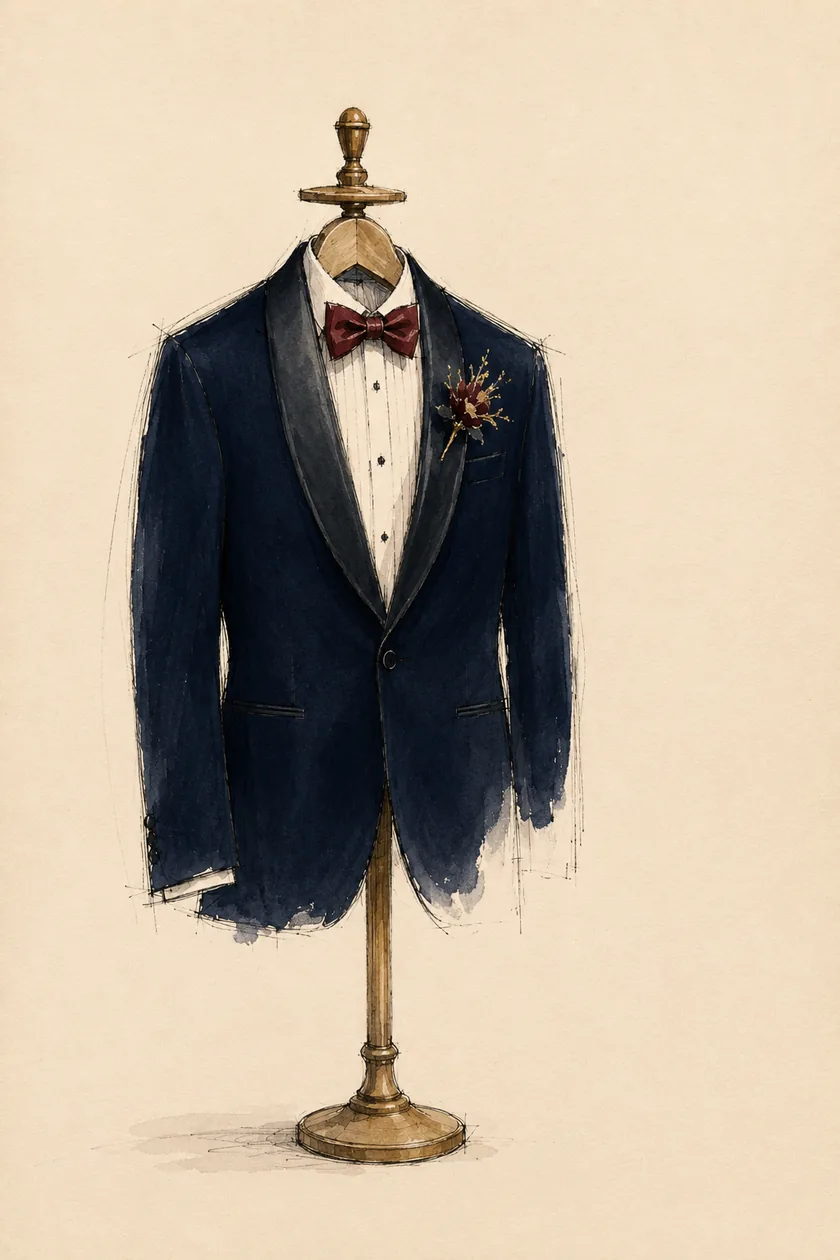
It doesn't, and anyone standing beside a man in real black tie will see why. A dinner jacket has lapels faced in silk, satin or grosgrain, buttons covered to match, and trousers with a silk braid down the outside seam. A suit has none of those, however dark it is. Midnight navy is a correct colour for a dinner jacket, but a navy suit is a different garment.
If the invitation says 'black tie optional' or 'formal', a dark suit with a plain tie is acceptable. If it says 'black tie', you need the real thing, rented or owned. A salesman who offers you the suit instead may simply not have a tuxedo in your size. A made dinner jacket takes three to four weeks, the same as a suit, and for anyone with a few black-tie evenings a year it often makes more sense than renting each time.
If the invitation says black tie, look for silk-faced lapels and a braid down the trouser leg; a suit has neither. Read more →
'He'll grow into it'
Putting a boy in the smallest men's size and promising he'll grow into it leaves him looking lost on the day, with shoulders past his own, sleeves over his hands and trousers pooling at the shoe. Shoulders can't be taken in later, and by the time he grows into them his arms and legs will have outgrown the rest.
Fit the boy in front of you. The shoulders should fit him now. The room for growth belongs in the seams and hems, where it can be let out later: the trouser waist at the centre back, the trouser and sleeve hems, and the jacket's back and side seams. Ask how much cloth is folded inside each. Order six to eight weeks before the bar mitzvah, so he's measured close to the date, and plan a check before any family simcha a few months after it.
Fit the boy's shoulders as they are today, and ask how much cloth is folded into the hems and seams for later. Read more →
General advice from thirty years at the bench, not client stories and never customer reviews. For the real thing: about Sam · his Google reviews · the practical guides.