Tzitzis explained: wool or cotton, the right size, and how it should sit
Updated August 2026 · by Sam Talkar
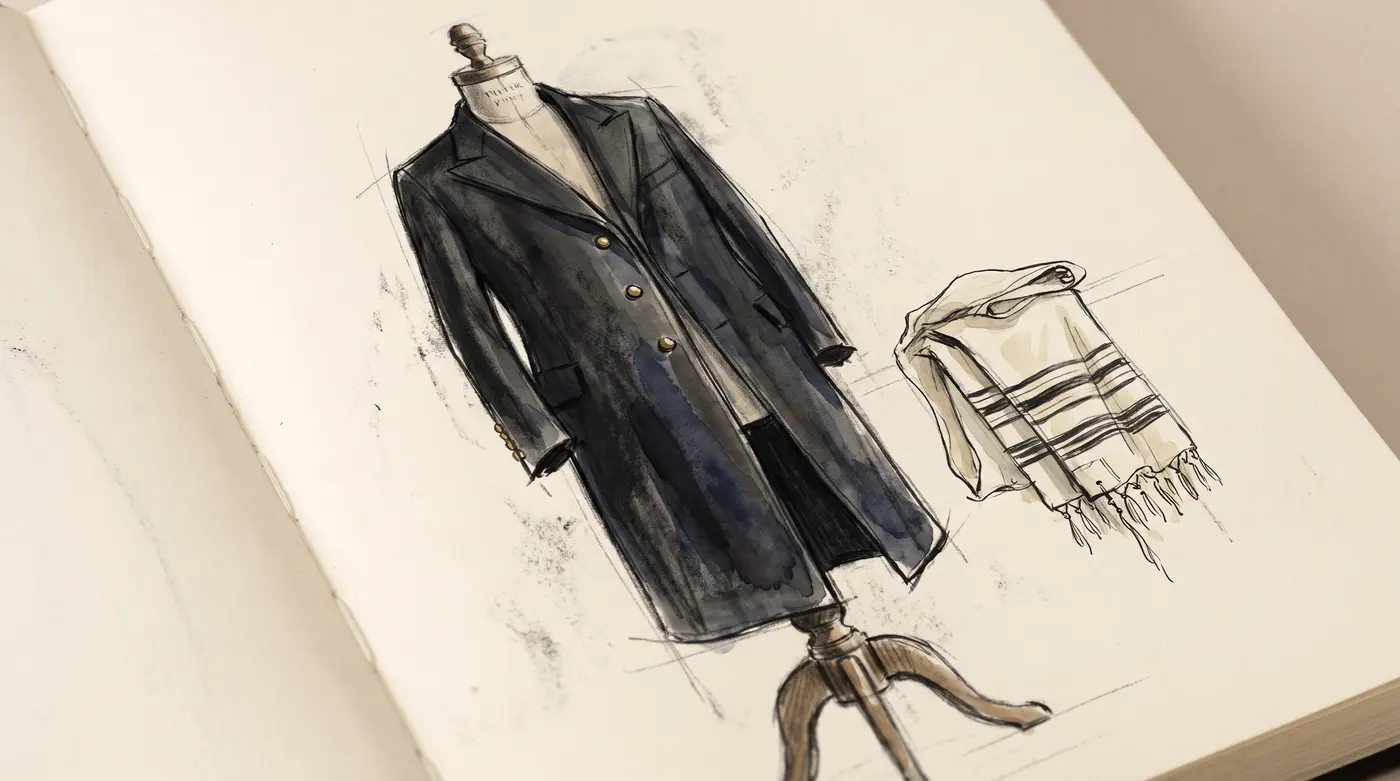
Tzitzis, properly a tallis katan, is the four-cornered garment worn under the shirt with fringes tied at each corner. The mitzvah of tzitzis applies to a four-cornered garment, and since almost nothing in modern dress has four corners, the tallis katan exists so a man can carry the mitzvah through an ordinary day. It is the garment he puts on first in the morning and the one nobody sees.
Two decisions actually matter: what it is made of, and whether it is big enough. Everything else is comfort.
Before any of it, the standing note for this series. Sam makes and alters these; he does not pasken. Where this guide reports a shiur or a machlokes it is reporting what is commonly cited, not telling you which to follow. Your rav decides that, and families differ.
Why wear a tallis katan at all?
The Torah commands fringes on a four-cornered garment. In a wardrobe of shirts, trousers and coats, no garment qualifies, so strictly speaking a man could go his whole life without ever triggering the obligation.
The tallis katan is the answer to that. It is a deliberately four-cornered garment, worn so the mitzvah is fulfilled every day rather than never. This is why it is worn under the clothes and why it looks the way it does: it is not decorative, it is a frame for the fringes at its corners.
Wool or cotton: which should you choose?
This is the real question, and it is not about comfort.
The Rishonim disagree over whether the Torah-level obligation applies only to wool and linen or to cotton as well. Both views appear in Shulchan Aruch, and the Rema rules that cotton garments do carry the biblical obligation. That ruling is why cotton is standard in so many Ashkenazi homes.
Against that, many poskim advise wearing wool, because a wool tallis katan fulfils the mitzvah according to every opinion with nothing left resting on a dispute. Sephardim typically wear wool for exactly this reason. Other poskim do not insist, and eminent talmidei chachamim have worn cotton.
The bench version of the same decision:
- Wool satisfies all opinions. It breathes better than people expect, holds its shape, and lasts. It can itch at first and it needs more care in the wash.
- Cotton is soft immediately, launders easily, and is far more practical for a child who will outgrow it inside a year. It is fully accepted among Ashkenazim on the Rema’s ruling.
For a boy’s first pair, cotton is the common and sensible choice. For a grown man who wants the machmir position, wool. Which one your family follows is a question for your rav, not for me.
How big does a tallis katan have to be?
Big enough to matter, and this is where cheap ones quietly fail. A garment under the shiur does not carry the mitzvah, however correct its fringes.
The sizes commonly cited:
- The preferred size is two amos long by one amah wide, measured front to back over the shoulder.
- The Mishnah Berurah’s minimum is an amah and a half by three quarters of an amah, which works out near 32 inches long by 16 inches wide.
- An amah itself is disputed. Rav Chaim Na’eh gives about 48cm, Rav Moshe Feinstein about 54cm, the Chazon Ish about 58 to 60cm. Follow the Chazon Ish and the preferred size lands near 48 by 24 inches. Follow Rav Na’eh and roughly 38 by 19 inches will do.
- The neck opening is itself a dispute. The Mishnah Berurah does not count it in the measurement; the Chazon Ish does.
The practical consequence for anyone buying: a mass-produced tallis katan labelled by a vague size may sit comfortably below the shiur your family holds by. Measure it. A tailor can measure it for you in a minute, and if it falls short there is no fixing it by adjusting the strings.
How should it fit under a shirt?
Flat, square on the shoulders, and invisible.
Three things separate one that disappears under a dress shirt from one that fights it:
- The shoulder line. If the neck opening is cut wrong the garment rides and bunches, and the bunch shows through a white shirt as a ridge across the back. This is the most common complaint and it is a cutting problem, not a laundry problem.
- The length. It should hang past the waistband so it does not ride up when he sits. Too short and it works its way out through the day.
- The cloth weight. Under a fine white shirt, a heavy tallis katan reads through as a visible rectangle. Either the shirt goes heavier or the tzitzis goes lighter. More on white shirt cloth →
Pullover and button-side styles both exist and the choice is largely communal and personal. A button-side is easier on a man who dresses in a hurry; a pullover sits flatter.
How do you care for tzitzis, and when do you replace them?
Wash the garment, protect the strings. The fringes are the mitzvah and they are the part that fails.
- Bag the strings or tie them together before washing so they do not tangle and abrade in the drum.
- Cool water, gentle cycle. Wool wants a wool setting or a hand wash; hot water will shrink a wool tallis katan meaningfully, and a shrunken one can drop below the shiur.
- Check the strings regularly. If strings tear the garment may become pasul, and a torn string is not always obvious at a glance. Checking is a habit worth building, not a once-a-year job.
- Replace rather than repair when the corners themselves wear through. Reinforced corners exist for this reason, and they are worth asking for.
Boys go through them quickly, which is the honest argument for cotton at that age. A grown man’s wool pair, cared for, lasts years.
What about techeiles?
Some men tie one string in techeiles, the blue dye whose identification was lost and which a number of communities now hold has been re-established. Others do not. This is squarely a question of what your community and your rav hold, and it changes nothing about the cloth, the cut or the fit.
Should you have one made?
Usually not, and it is worth saying so plainly. A well-made tallis katan off the shelf in the right cloth and the right size is perfectly good, and most men should simply buy one and check that it meets their shiur.
Where a tailor genuinely helps is the exception: a man who is very tall, very broad, or hard to fit, for whom every standard size either falls short of the shiur or bunches across the shoulders. That is a real fitting problem and it has a real solution. Suits for hard-to-fit bodies →
For everyone else, the useful thing a tailor can do is measure what you already own and tell you honestly whether it makes the size. Bring it in.