The upsherin wardrobe: a boy's first kippah and first tzitzis
Updated August 2026 · by Sam Talkar
The upsherin is the ceremony at a boy’s third birthday where his hair is cut for the first time and his peyos are left. Sephardim call it a chalakah. In Chassidish and many Sephardi homes it is also the day he first puts on a kippah and a pair of tzitzis, which makes it the true beginning of everything else in this series. His first mitzvah and his first garment arrive on the same afternoon.
It is a small ceremony and an enormous one. Friends come, everyone takes a turn with the scissors, and a boy who was a baby that morning goes to bed looking like a boy.
Is the upsherin universal?
No, and it is worth saying so before anyone feels they are doing it wrong.
The haircutting ceremony is largely a Chassidish and Sephardi custom. Many Litvish, yeshivish and German families do not hold one at all. Their sons still begin wearing a kippah and tzitzis around the same age; it simply happens quietly, when the child is ready, without a gathering.
Both are entirely normal. If your family has never done this, nothing is missing.
What does a boy actually receive?
Three things, and only the first two are garments.
- His first kippah, which he will now wear every day for the rest of his life.
- His first tzitzis, a small tallis katan worn under his shirt.
- His peyos, left uncut at the temples while the rest is trimmed. Not bought, but the reason the day exists.
From here he starts being taught to say brachos and the Shema. The clothing and the learning begin together, which is the whole design of it.
How do you size a three-year-old’s tzitzis?
This is the part parents ask about and the part shops answer badly.
A tallis katan has to meet a minimum size to carry the mitzvah at all, and the shiurim are debated. The complication at this age is obvious: a garment big enough to make the shiur can swamp a small three-year-old. Children’s sizes are made to balance the two, and which shiur your family holds by is a question for your rav rather than for the shop. The sizes explained in full →
The practical notes:
- Cotton, for a boy this age. It is soft immediately, washes constantly, and he will outgrow it inside a year regardless. Wool is the machmir choice for a grown man; it is a hard first garment for a child.
- Buy more than one. He is three. One will always be in the wash and one will always be lost.
- Check the strings often. Small boys are hard on fringes, and torn strings are not always visible at a glance.
- Expect to replace it, not alter it. Growing out of tzitzis is not a tailoring problem, it is arithmetic.
What kippah stays on a three-year-old?
The eternal question, and the honest answer is: clips.
A small kippah on a small head with a fresh haircut has nothing to hold onto. Most parents settle on a slightly larger kippah with two clips, and accept that it will be found under furniture regularly. Velvet slides, suede grips better, and a knitted one has a little give that helps.
Buy several identical ones. The one you cannot replace is the one that will vanish.
What should he wear for the day itself?
The upsherin is photographed heavily and the photographs get looked at for fifty years, so it is worth a little thought and not a great deal of money.
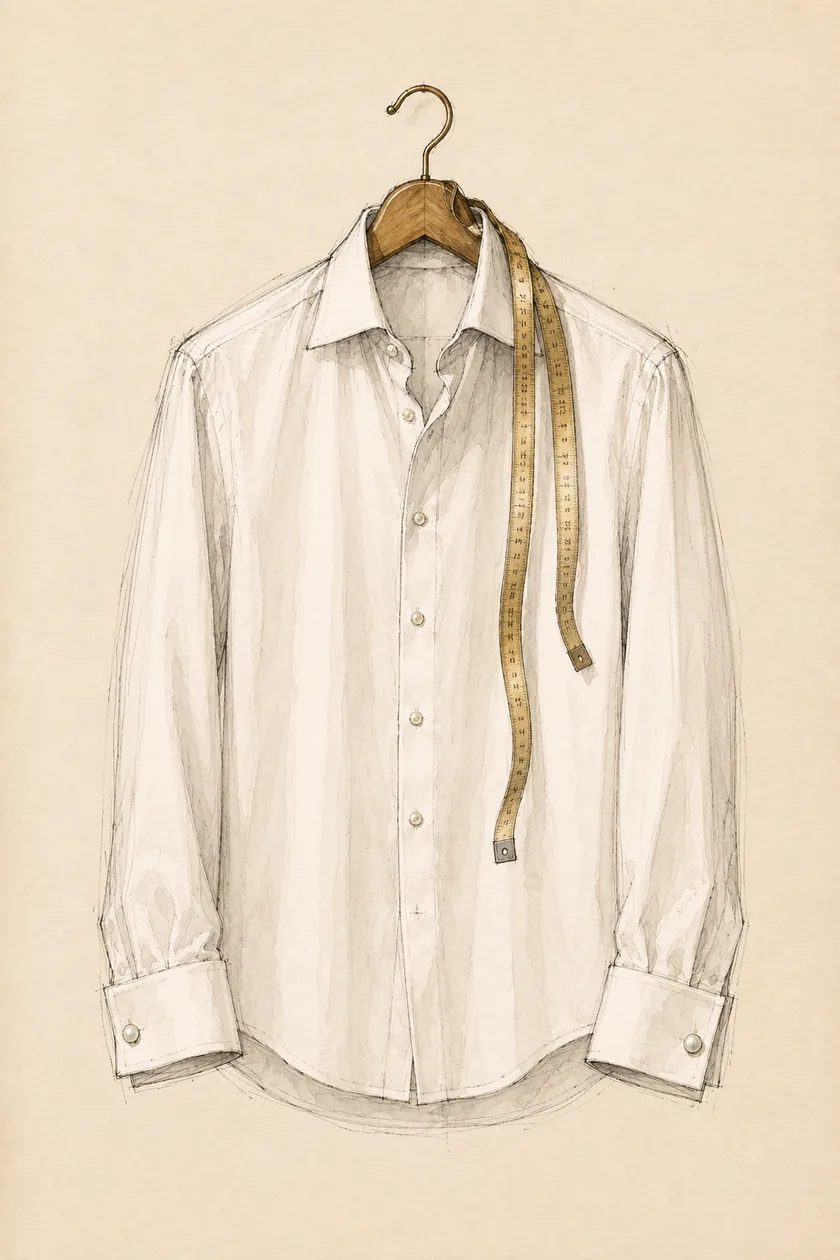
Most boys wear a white shirt and dark trousers, sometimes a small vest, and the new kippah. That is genuinely enough. He is three, the day involves cake and scissors, and anything precious will not survive contact with either. More on white shirts →
The one piece of advice worth giving: dress him in something he can move in. A boy who is uncomfortable will spend the entire ceremony pulling at his collar, and that is what the photographs will show.
Is there anything a tailor does here?
Very little, and it would be dishonest to invent a role.
A three-year-old’s clothes are bought, worn hard and outgrown. Nobody should be having a suit made for a boy this age, and Sam would tell you the same if you asked. The first time a boy genuinely needs a tailor is his bar mitzvah, ten years later, when he stands in front of everyone he knows and it is the first suit ever cut for him rather than handed down.
What is worth doing now is keeping something. Families put away a first kippah far more often than they put away a first pair of shoes, and nobody has ever regretted it.