Sukkos with children: eating outdoors, chol hamoed, and clothes that survive being climbed on
Updated August 2026 · by Sam Talkar
Sukkos begins on 26 September and runs through Simchas Torah on 4 October. It is the only chag where the meals happen outdoors, in Toronto, as the weather turns. It is also the one with the most child-handling per hour of any week in the year.
This is the part of the season where good clothes get ruined, and it is entirely avoidable with a bit of planning.
Eating outside as the season turns
The sukkah does not have a thermostat. Over these nine days Toronto normals slide from around 21.9°C in late September to roughly 15.6°C by early October, and evening in a sukkah is colder than the daytime number suggests, because you are sitting still, outdoors, after dark, often under open sky.
The instinct is to buy a heavier suit. The better answer is to layer, and keep the suit the same.
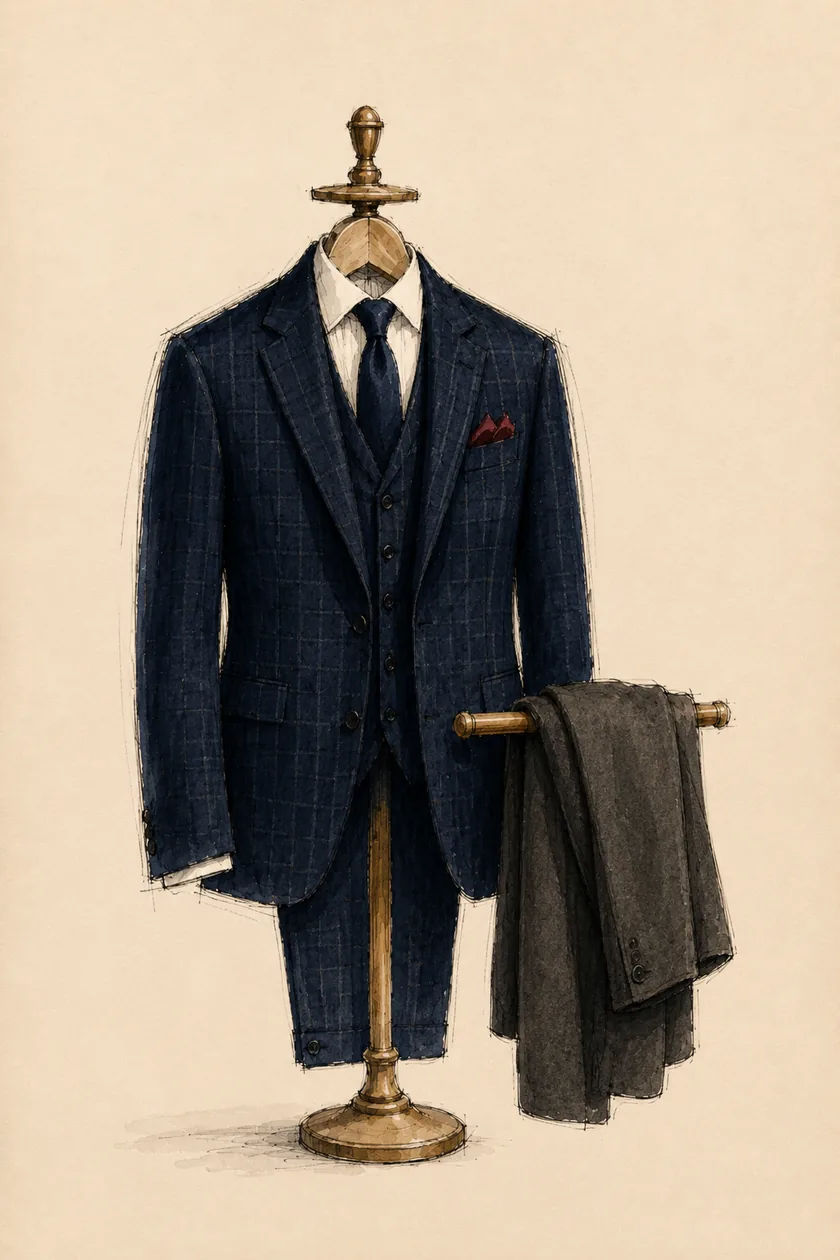
- A waistcoat is the most useful and least discussed layer here. It warms the core without adding bulk at the arms, it looks correct at a yom tov table, and it comes off indoors without leaving you in shirtsleeves.
- A fine knit under the jacket does the same job less formally.
- A proper coat for the walk, rather than a heavier suit for the whole evening. You are cold for ten minutes outside and warm for two hours at the table; dress the ten minutes separately.
- The mid-weight suit from part two covers this whole span. A 260 to 280g cloth plus a waistcoat handles a cold sukkah better than a 340g suit handles a warm one. Cloth for the season →
A small practical note: sukkah decorations drip, schach sheds, and a table under open sky collects the odd leaf. Whatever you wear will pick something up.
The three-tier wardrobe for the week
The mistake is treating all nine days the same. They are not, and dividing them is what protects the good clothes.
- Tier one, the yom tov days. 26 and 27 September, then Shmini Atzeres and Simchas Torah on 3 and 4 October. This is the good suit. Remember that in 2026 each of these runs Friday evening through Sunday night, so it is two days of wear with no laundry in between and you want two shirts. Part one →
- Tier two, chol hamoed weekday davening and meals. Smarter than casual, not the good suit. A jacket and trousers rather than a matched suit is the sensible answer, and a sport coat that can take a knock is worth more here than a second suit.
- Tier three, chol hamoed trips. Genuinely washable clothing. Whatever you wear to a farm, a zoo, or a park with children in tow is going to be washed, not dry cleaned.
The whole point of the split is that Simchas Torah is at the end. If the good suit does its week in tier one only, it arrives at 4 October still looking like a good suit. If it does all nine days, it does not.
Clothes that survive children
Nobody writes this down, so plainly:
- Dark cloth with texture hides everything. A charcoal with a faint pattern, a navy bird’s eye, a herringbone. Flat pale cloth shows every handprint. This is the single highest-return decision.
- Wool sheds a spill far better than a blend. Wool’s natural structure resists water long enough to blot, which is exactly the window you need when something goes over at the table.
- Two-ply cotton shirts survive the wash cycle they are about to receive. The white shirt →
- The waistcoat again: it takes the front-of-body punishment that would otherwise land on the shirt, and it is far easier to clean than a jacket.
- Pockets that close matter more than usual when a small person is going through them.
The four things that actually stain, and what to do in the first minute
Sukkos produces a predictable set of accidents. What you do immediately decides whether it is permanent.
- Wine. Blot, never rub. Rubbing drives it into the weave. Cold water only; heat sets it.
- Grease, from a yom tov meal. Do not add water. Blot, and let a cleaner deal with it. Water on a grease mark spreads the ring.
- Wax, from candles or a sukkah. Let it harden completely, then break it away. Warm wax smeared into wool is a far worse problem than hard wax sitting on top of it.
- Mud and grass, from chol hamoed. Let it dry fully, then brush it out. Wet mud worked at with a cloth becomes a stain; dry mud is largely dust.
The general rule for all four: the first minute matters more than the dry cleaner does, and the most common mistake is warm water applied energetically.
Dressing children for it
Briefly, because the same logic applies with the volume turned up.
Buy for the growth, not for the fit today, and let the tailor leave real seam allowance so a jacket can be let out rather than replaced. A boy who is nine at Sukkos may be meaningfully bigger by Pesach. Dark and textured for the same reason as adults. And accept in advance that chol hamoed clothes are consumables.
The one place to spend properly is a bar mitzvah year, where the suit is being looked at rather than lived in. The bar mitzvah suit →
Simchas Torah, and the end of the season
The last day is the most physical. Dancing, for hours, often carrying a child on one arm, frequently in a room that has become very warm despite the October date outside.
Three things: wear the mid-weight rather than the heavy suit, because the room will not stay cold; make sure the jacket is one you can dance in, which comes back to the shoulder and the vents from part three; and have a fresh shirt for a day that is going to ask a great deal of the one you start in.
Then it is over, and the suit goes to be cleaned and hung properly, rather than back in the wardrobe as it is. That last step is what decides whether it is ready next Rosh Hashanah.
Part three: built to sit → · Part one: the dates and the order deadline →