The kapota: cut, fabric, and what most tailors get wrong.
January 21, 2026
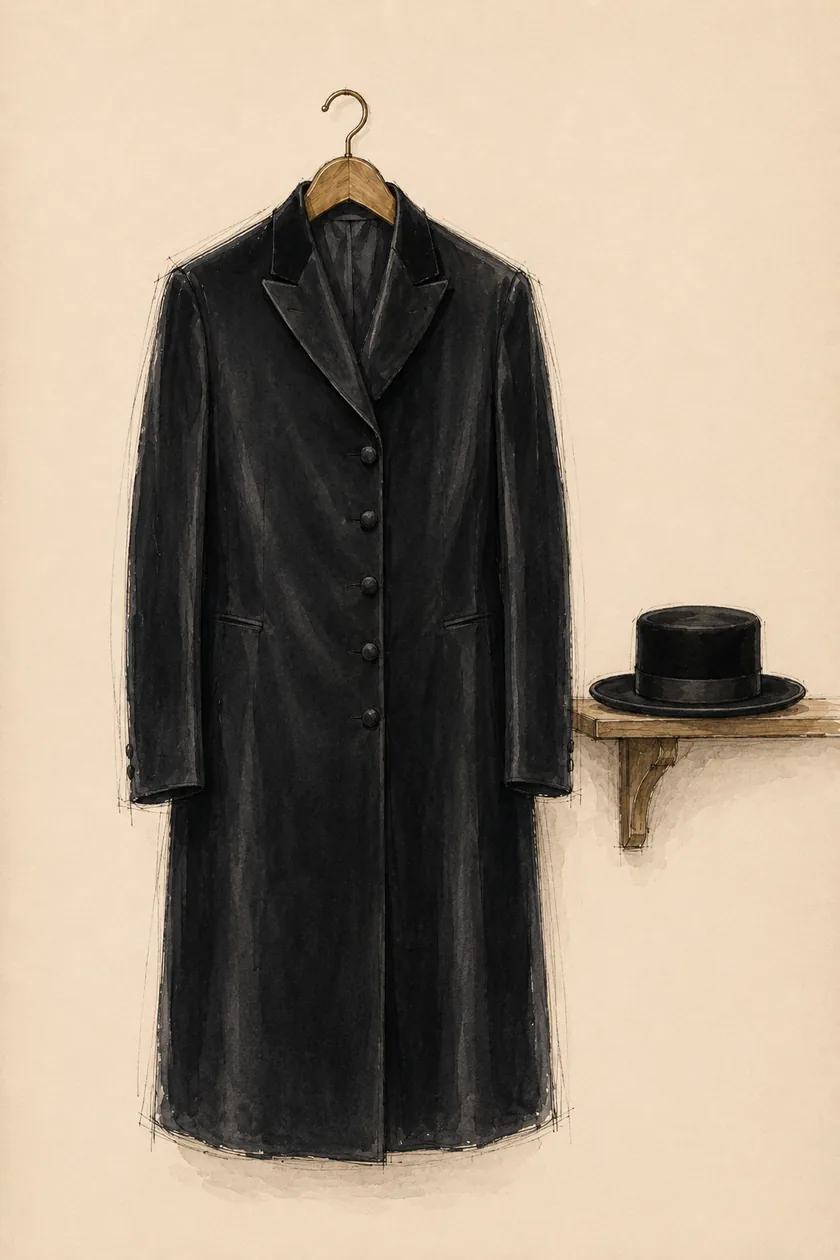
A kapota is not a long jacket. That is the first thing most tailors get wrong, and everything else follows from it. It is its own garment, with its own logic: the way it closes, the way it drapes from the shoulder, the allowance it makes for a gartel and for tzitzis, the fall of the skirt so that it moves properly when a man walks to shul.
Cut from the shoulder, not the waist
A business jacket is shaped at the waist to flatter. A kapota is balanced from the shoulder to hang clean and straight, without clinging. Get the shoulder and the back balance right and the whole garment behaves. Get it wrong (cut it like a suit jacket and simply make it longer) and it pulls at the closure and breaks at the hip. No amount of pressing fixes a balance problem.
Fabric that holds a line
Fine wool worsted for daily wear; a good satin or a heavier fabric for Shabbos and Yom Tov. The fabric has to hold a crisp vertical line down the front and take a press that lasts through a long davening. Cheap fabric goes limp by mincha.
Hand-finished where it counts
Buttonholes, closures and the hem are finished by hand. It’s slower, and it’s the difference between a garment that lasts one season and one a father passes to a son. We keep the family pattern on file, so the next bekishe, the next bar-mitzvah suit, begins where the last one left off.
That’s the shortcut that never works: treating a kapota like a suit. Done properly, it isn’t a costume and it isn’t a uniform. It’s the fabric of a community’s most personal moments, and it deserves the same patience as a wedding suit.